
Seoul Court Fines Chinese Student for Destroying Falun Gong Banners; Neither Ruling Addresses Motive
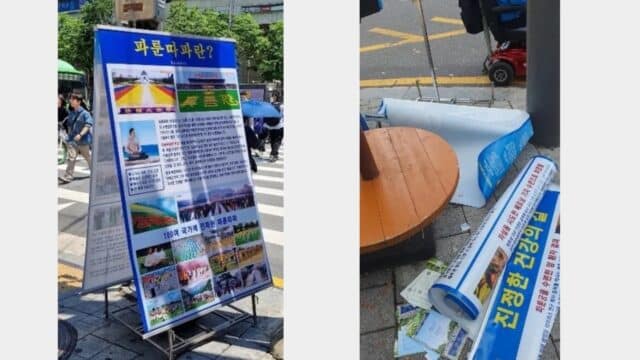
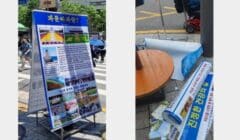
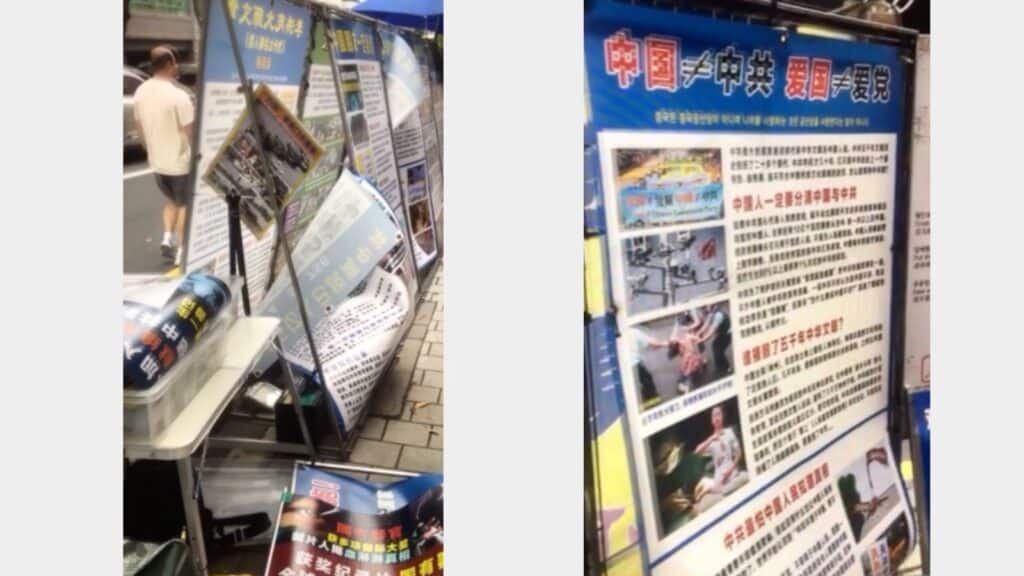
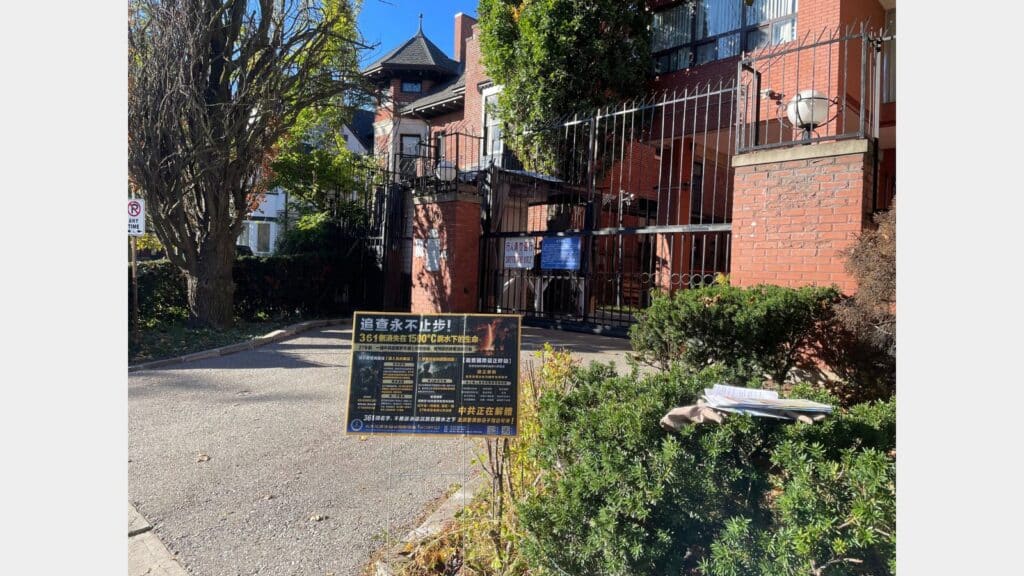
Left: a Falun Gong information display on a street in Gwangjin-gu, Seoul. The heading reads “What is Falun Dafa?” Right: banners, a table and leaflets on the ground after the incident on October 19, 2025. The penal order records that three banners were torn by hand and a table was overturned. (Photo: Mr. Lee)
Two rulings by the Seoul Eastern District Court have penalized a Chinese international student for destroying a Falun Gong practitioner’s banners as damage to property. Neither written ruling addresses the motive for the act or whether it formed part of transnational repression; whether the judges considered these questions is not stated in the documents.
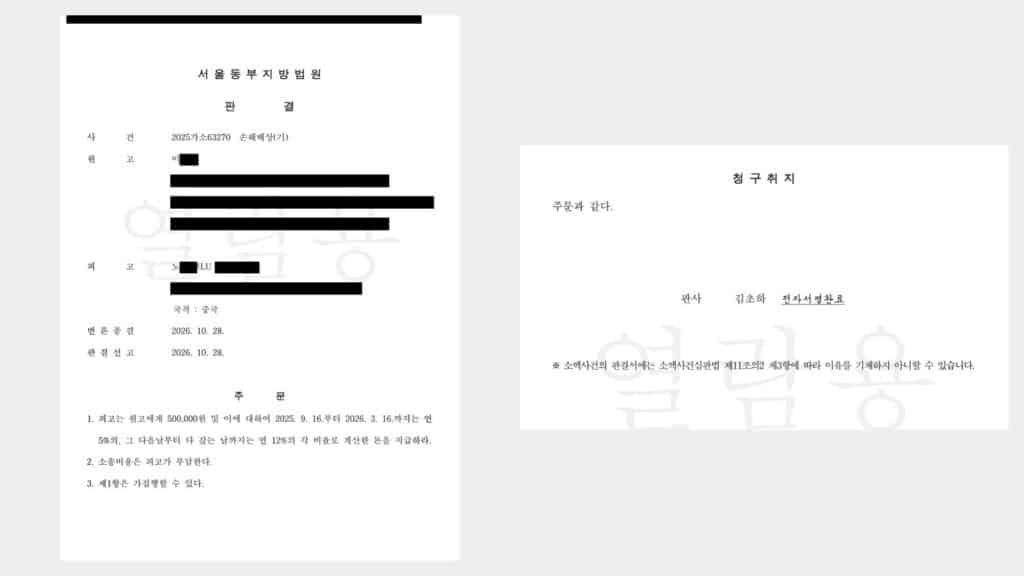
A criminal penal order issued on March 23, 2026, fined him 700,000 won, and a small-claims judgment issued on October 28, 2026, ordered him to pay 500,000 won in damages. The first was issued without a trial; the second was issued without reasons, as Korean small-claims law permits.
Statements recorded in two comparable incidents this year, one in South Korea and the other in Canada, indicate a motive linked to the Chinese Communist Party’s (CCP) policy targeting Falun Gong. Taiwan, which has faced similar cases, is now moving to address that motive in law.
What the court records show
The facts below come only from three Seoul Eastern District Court documents: the penal order, the defendant’s preparatory brief, and the civil judgment. The Falun Dafa Information Center reviewed the official documents provided by Mr. Lee, the victim of this case.
The act. According to the penal order, at about 11:30 a.m. on October 19, 2025, on the street at 103 Neungdong-ro, Gwangjin-gu, Seoul, the defendant saw a rally banner set up by Mr. Lee, calling for an end to the Chinese government’s persecution of Falun Gong. The order states that the defendant “became angry,” tore three banners by hand and overturned a table. The banners were valued at 500,000 won (about US$345). The defendant is identified as a Chinese national studying at a Seoul university. The civil file gives his surname as Lu.
The criminal penalty. On March 23, 2026, Judge Lee Jun-gu issued a penal order under Article 366 of the Criminal Act (damage to property), without a trial. Mr. Lu was fined 700,000 won (about US$480), with one day in a workhouse for every 100,000 won left unpaid. Neither side asked for a formal trial. Mr. Lu later told the civil court he had paid the fine in full.
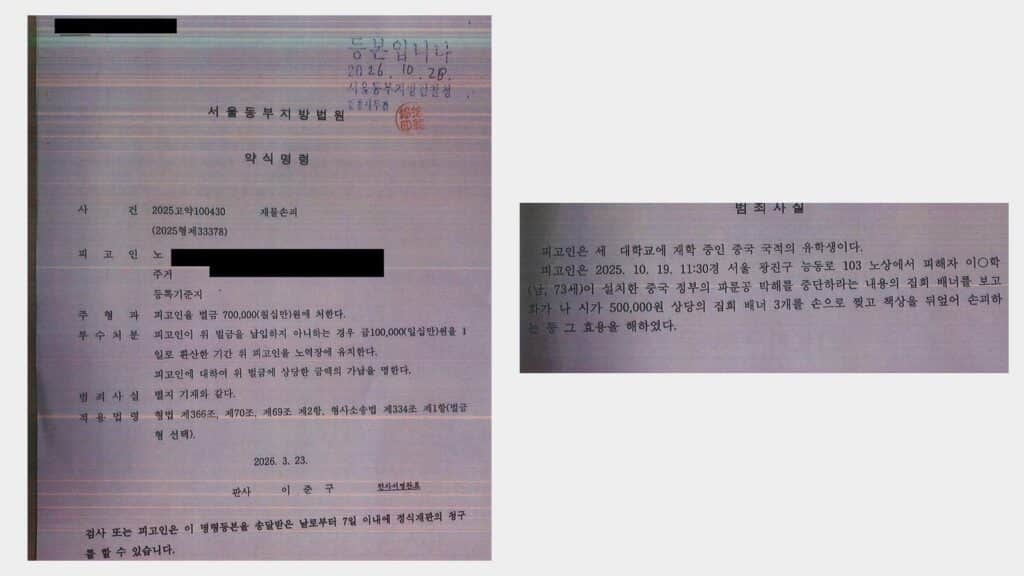
The civil claim. Mr. Lee sued for 500,000 won in small claims. In court mediation (Case 2026 Meo 5588), the court proposed that Mr. Lu pay that sum. Mr. Lu accepted; Mr. Lee objected, so the case returned to litigation. Mr. Lu did not attend the October 28, 2026, hearing. He asked the court to decide on his written filings, citing concern for his safety if he met Mr. Lee in person. Judge Kim Cho-ha ruled the same day: 500,000 won plus interest (5% a year from September 16, 2025, then 12% from March 17, 2026), with costs to Mr. Lu and immediate enforcement allowed. The judgment gives no reasons, relying on Article 11-2(3) of the Small Claims Case Adjudication Act.
The question of motive
Mr. Lee’s written submissions linked the act to a particular country or political force and attached news reports. Mr. Lu’s brief rejected this. He said he acted from a sudden surge of emotion after reading the display, not on the instruction or plan of any country, party, organization or person. No court tested either account.
Mr. Lu’s explanation establishes what triggered the act: a public message that the Chinese government persecutes Falun Gong. It does not explain why that message provoked him. Because the record contains no statement from Mr. Lu at the scene, the question can be examined only by comparison with incidents in which the attackers’ words were recorded.
Two comparable incidents: Jeju and Toronto
In both incidents, the target was the same kind of display as in Seoul, and the attackers’ words were recorded on video or in police and witness accounts. The facts below come from the Falun Dafa Information Center’s reports and from video reviewed by the Information Center.
Jeju Island, June 2, 2026. At 6:08 p.m., according to the police record, three Chinese men confronted eight practitioners holding a lawfully notified assembly outside the Shilla Duty Free Store. One of them pulled a picket sign from an elderly woman, knocking her down, and kicked a display board. One man struck a 63-year-old practitioner in the face and twisted the hand of a 70-year-old practitioner; both later submitted medical certificates. Police recorded 560,000 won in property damage. Officers took the three to Jeju Seobu Police Station under voluntary accompaniment rather than arrest, questioned them and released them. According to the assembly’s organizer, Mr. Park, the men left South Korea before police could call them back, and the case was referred to prosecutors without them (updated October 29, 2026).
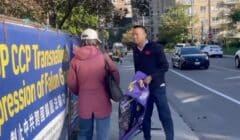
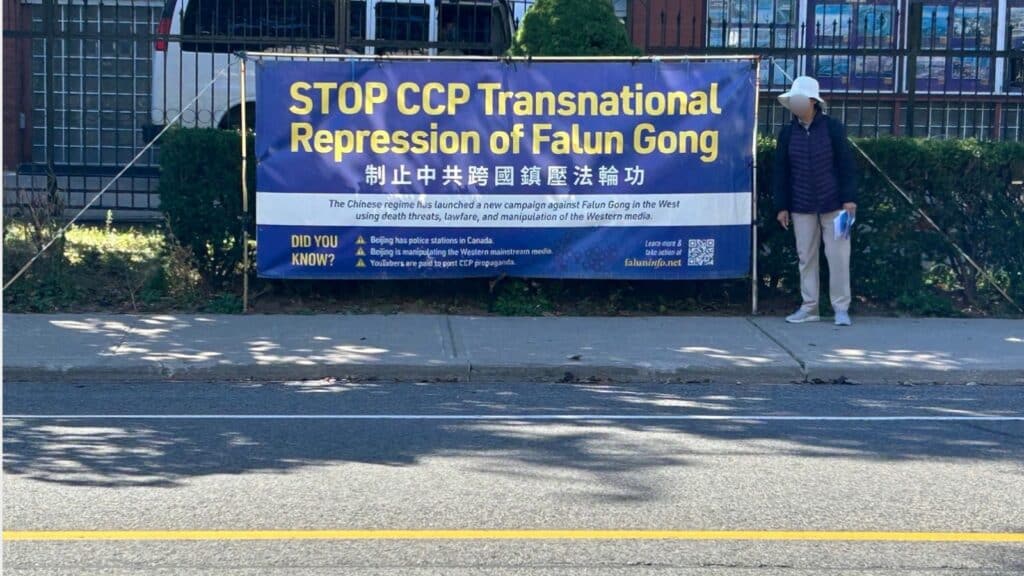
Toronto, September 22, 2026. A man wearing a jacket with a PRC flag insignia tore down banners and display boards outside the Chinese Consulate at 240 St. George Street and shoved a 62-year-old practitioner surnamed Li, whose chin was cut. He tried to kick the practitioner filming, surnamed Geng, but missed. A second man recorded the confrontation. The man then crossed the street, made a phone call and was picked up by a car before police arrived. As of November 12, no suspect had been publicly identified. The consulate told Rebel News that the man had no connection to it, and no connection has been established. In an October 22 letter to MP Jacob Mantle, Foreign Affairs Minister Anita Anand wrote that the incident is under investigation by local police and the Royal Canadian Mounted Police (RCMP).
Attackers’ statements in Jeju and Toronto
The recorded statements show what the attackers objected to and on whose behalf they claimed to act. The table groups them by subject; each entry notes whether it was captured on video or reported by a witness or police record.
| Subject | Statement | Incident | Basis |
| The display | “Take it down!” “Clear away all this stuff! Or else I will smash it all.” | Jeju | Video of the incident, with English subtitles, from the Information Center |
| The display | “I’m telling you. This is an illegal thing. Don’t you know?” | Toronto | Video from the X account @WhatisonToronto and English subtitles reviewed by the Information Center |
| The CCP | The men demanded that the complainant take down placards criticizing the CCP | Jeju | Complainant’s account in the police certificate of incident facts (Case 2026-007266) |
| State authority | “Call the [Chinese] embassy!” (one attacker, wearing glasses, to another) | Jeju | Video of the incident, with English subtitles, from the Information Center |
| Chinese Territory | 「你知不知道這是什麼地方?這是中國領土,你知不知道?」 “Do you have any idea where this is? This is Chinese territory. You know that?” | Toronto | Video from the X account @WhatisonToronto and English subtitles reviewed by the Information Center |
| Chinese law | Invokes the Anti-Secession Law and accuses the practitioners of splitting the country | Toronto | Video from the X account @WhatisonToronto and English subtitles reviewed by the Information Center |
| Lethal threat | 「我可以槍斃你,知不知道?……槍斃你,信不信?」 “I can shoot you dead. Do you know that? … I will shoot you to death. Believe it or not?” Also threatens to slam her to death | Toronto | Video from the X account @WhatisonToronto and English subtitles reviewed by the Information Center |
| The host country | “[Expletive] Canada.” “I’ll [expletive] take you down right at your doorstep in Canada. You believe it or not?” (in reply to bystanders saying “This is Canada!”) | Toronto | Video filmed by Ms. Geng and provided to the Information Center, with Mandarin and English subtitles |
| Others involved | Calls to someone off camera to help him film; a second man records | Toronto | Video from the X account @WhatisonToronto and English subtitles reviewed by the Information Center |
Three features are common to the statements. First, the objection is to the message, not to the practitioners as individuals; the Jeju complainant’s account identifies the target as placards criticizing the CCP. Second, the attackers in both incidents invoked the Chinese state: in Jeju, one called for the Chinese embassy to be contacted; in Toronto, the attacker framed the act in terms of PRC territory and PRC law, and dismissed the host country’s law when bystanders invoked it. Third, neither attacker acted alone: in Jeju, three men acted together; in Toronto, a second person filmed and a vehicle collected the attacker after a phone call.
These statements establish the attackers’ stated reasons and that they did not act entirely alone. They do not establish that any state body directed them. In neither case have charges been announced.
The trigger in Seoul was the same as in both incidents: a public display stating that the Chinese government persecutes Falun Gong.
What the CCP expects of Chinese people abroad
The Falun Dafa Information Center has documented how the CCP’s campaign against Falun Gong is organized and how it extends outside China. Five of its findings bear on the cases in this article.
- Falun Gong is officially treated as a threat to be eliminated. The CCP created the 610 Office on June 10, 1999, as an extralegal task force charged with eliminating Falun Gong, with branches at every level of government and in companies and universities. Speeches and work reports by senior security officials as recently as 2023 still list the crackdown on Falun Gong as central to the Party’s security.
- The public was taught to see Falun Gong as an enemy. From 1999, state media ran a sustained campaign against the practice, and the Party labeled it an “evil cult.”
- Chinese diplomatic missions carry the campaign abroad. Chen Yonglin, a former Chinese consular official in Sydney, testified to the U.S. Congress in 2005 that every Chinese mission abroad must have at least one official in charge of Falun Gong affairs. Leaked 610 Office documents call for mobilizing non-governmental forces and overseas Chinese community leaders against Falun Gong.
- Students and the diaspora are enlisted. According to Chen, the Party’s United Front Work Department uses overseas Chinese communities, including students, to pressure and monitor Falun Gong practitioners abroad. Chinese Students and Scholars Associations, which are tied to local consulates, have tried to censor or penalize Falun Gong activities on university campuses.
- South Korea is a focus of these efforts. Of 135 documented incidents of CCP interference with Shen Yun performances, 19 occurred in South Korea, second only to the United States, including a 2016 cancellation in Seoul after pressure from the Chinese embassy.
None of these sources mentions the Seoul case, and none links Mr. Lu to any of these bodies.
Two possible motives
The evidence points to two possible motives. Either one can make an attack part of transnational repression: intimidation, harassment, violence or coercion directed at people abroad because they criticize a foreign government. Taiwan’s Mainland Affairs Council defines it as such acts carried out by a foreign power or its agents against individuals or communities. Under both motives the result is the same: the CCP’s policy of suppressing Falun Gong is carried out against practitioners outside China.
- Following orders. Someone acting for the Chinese state told the attacker to do it, or encouraged or rewarded him. Signs of this would include planning and coordination with others. Jeju and Toronto show some of these signs: in Jeju, three men acting together and a call to contact the Chinese embassy; in Toronto, a second person filming, a phone call and a car arriving to collect the attacker. These signs fit this motive but do not prove it. In none of the three cases has anyone been shown to have acted on orders.
- Acting on beliefs the Party instilled. No one gave an order. The attacker acted on his own, but on beliefs about Falun Gong shaped by more than 25 years of CCP propaganda, which portrays the practice as a cult and an enemy of China. To such a person, a banner criticizing the Party is an attack on China itself, and stopping it feels like a duty. The Toronto attacker’s claims about “Chinese territory” and Chinese law fit this pattern.
The Information Center has documented both patterns: some attackers are themselves deceived by Party propaganda, while other attacks are coordinated by Chinese diplomats or other CCP agents. The line between the two is not always sharp, because the Party mobilizes overseas Chinese communities and students through its diplomatic missions and United Front networks without issuing orders for specific acts.
The two motives differ in how directly they fit the definition of transnational repression, not in their effect. An attack carried out on a Chinese state actor’s instructions is transnational repression in its plainest form. An attack carried out without instructions, by someone acting on the Party’s view of Falun Gong, has the same effect on its targets: they are intimidated for publicizing the CCP’s persecution.
On the court record, the second motive fits the Seoul case better. The penal order names only Mr. Lu, and he says no one instructed him. Jeju and Toronto show more signs of the first, enough to justify an investigation into whether anyone directed the attackers.
Legislative responses elsewhere
Other jurisdictions have begun to treat motive and foreign direction as legally relevant, rather than charging only the physical act.
Taiwan. Taiwan’s government has stated that its current laws do not adequately deter transnational repression and is preparing to change them. At a Legislative Yuan committee hearing on November 5, 2026, Justice Minister Cheng Ming-chien said the ministry is studying amendments to the Anti-Infiltration Act to create transnational repression offenses with heavier penalties, along with asset confiscation and internet-related measures. According to the ministry’s written report, assaults, paint attacks and covert surveillance are currently prosecuted as injury, property damage, intimidation or privacy offenses, mostly carrying sentences of up to five years, which do not reflect the harm to democracy and the rule of law. Prosecutors, the ministry said, would trace such cases upstream and hold local collaborators responsible. Mainland Affairs Council Deputy Minister Liang Wen-chieh said a reporting hotline for victims will be set up. He cited a case close to Seoul’s: when the studio of a Hong Kong activist in Taiwan was splashed with red paint, police might have treated it as ordinary property damage, but the council suspected a link to the activist’s past activities and referred it to a cross-agency response platform. An opposition legislator, Weng Hsiao-ling, cautioned that designating a foreign hostile force requires evidence. Local governments have moved as well. Between May 29 and October 14, 2026, 17 of Taiwan’s 22 city and county councils passed motions against transnational repression, in response to bomb threats against screenings of State Organs, a documentary on forced organ harvesting in China; some of the motions name the CCP.
Canada. The Countering Foreign Interference Act of 2024 covers intimidation, threats and violence carried out at the direction of, for the benefit of, or in association with a foreign entity. The Falun Dafa Information Center has asked the Royal Canadian Mounted Police (RCMP) and the Canadian Security Intelligence Service (CSIS) to assess whether it applies to the Toronto incident.
Possible measures for South Korea. These examples, together with the Seoul and Jeju cases, point to four measures South Korea could consider:
- An offense or aggravating circumstance for acts against persons or property committed at the direction, for the benefit, or with the support of a foreign state.
- Guidance requiring police and prosecutors to examine possible foreign direction when an attack targets a group’s public expression about a foreign government.
- Assessment of flight risk at the outset when foreign suspects are involved, given that the Jeju suspects left the country before questioning was complete.
- Recording of motive in decisions involving politically targeted acts, so that the basis of the penalty is clear.