
August–October 2026 Transnational Repression Update
False-Flag Threats, Assaults During Xi Jinping's U.S. Visit, and Cyberattacks Target Falun Gong Communities (as of October 31, 2026)

A man wearing a jacket bearing a PRC flag tears down a Falun Gong information display outside the Chinese Consulate in Toronto on September 22, 2026. (Source: Nora Geng)
This update covers three months, August through October 2026, combined with what the Falun Dafa Information Center (FDIC) documented currently. During this period, incidents of transnational repression targeting practitioners of Falun Gong and Shen Yun Performing Arts, a New York–based classical Chinese dance company founded by Falun Gong practitioners, continued, with at least 18 documented cases spanning the United States, Canada, France, the United Kingdom, Italy, Latvia, Austria, Greece, Japan, and Taiwan.
The period’s main tactic remained impersonation: senders used the names of Falun Gong’s founder, a Shen Yun master of ceremonies, Falun Gong–related organizations, and Chinese dissidents to send bomb, poisoning, and assassination threats, many claiming Falun Gong itself as the author.
In addition, physical assaults returned, with two practitioners attacked within three days around Chinese leader Xi Jinping’s September visit to the United States. And websites run by a media outlet founded by Falun Gong practitioners and by the Global Tuidang Center were hit by large-scale cyberattacks.
Physical assaults and intimidation
Two practitioners were physically assaulted in the days around Xi Jinping’s September 23–25 visit to the United States, and a third was photographed and threatened at a rally in Athens.
On September 22 in Toronto, Canada, a man wearing a jacket bearing a People’s Republic of China (PRC) flag attacked a Falun Gong information display outside the Chinese Consulate, tearing down banners and display boards and shoving Na Li, a 62-year-old practitioner who tried to stop him. Ms. Li, who had set up the long-standing display with another practitioner at around 9:15 a.m., said her chin was cut in the struggle. Video recorded by practitioner Nora Geng, and posted with her permission by the X account @WhatisonToronto, shows the man insisting in Mandarin that the public sidewalk is Chinese territory, invoking China’s Anti-Secession Law, and accusing the practitioners of splitting the country. He threatened Ms. Li:
“你知不知道這是什麼地方?這是中國領土,你知不知道?······我可以槍斃你,知不知道?······槍斃你,信不信?”
(Translation) “Do you have any idea where this is? This is Chinese territory. You know that?…I can shoot you dead. Do you know that?…I will shoot you to death. Believe it or not?”
Ms. Geng said the man tried to kick her as she filmed but missed. A second man stood nearby recording the confrontation, and two passersby intervened. When he was finished, the man crossed the street, made a phone call, and was picked up by a car before police arrived. Toronto police confirmed receiving a disturbance call at about 9:35 a.m. and said they are investigating; as of October 6, no suspect had been publicly identified and no charges announced. The attack was reported to the Toronto Police Service’s 53 Division and, by a Falun Gong community liaison, to the Royal Canadian Mounted Police. Rebel News reported that the Chinese Consulate General in Toronto denied any connection to the man; no connection has been established. In an October 22 letter to Member of Parliament Jacob Mantle, Canada’s Minister of Foreign Affairs, Anita Anand, wrote that the incident is under investigation by local police and the RCMP.
On September 24 in Washington, D.C., the day of the U.S.–China leaders’ summit, Falun Gong practitioner Xin Qin was assaulted near a practitioners’ banner protest on the 1200 block of Constitution Avenue NW, opposite the headquarters of the U.S. Environmental Protection Agency. Pro-Beijing counter-demonstrators stood beside the practitioners and across the street throughout the day. At about 1:14 p.m., according to two eyewitnesses and timestamped photographs taken by one of them, a woman tried to pull a banner from Ms. Xin’s hands and police officers blocked her; a second woman, carrying a Chinese flag, also went for the banner and was blocked. At about 3:23 p.m., according to an eyewitness, Ms. Xin crossed the street to photograph the banners, and the first woman, whom two eyewitnesses identified as Li Huahong, blocked her path with several others. Ms. Xin said Li seized her with both hands and took her to the ground; three or four others then struck her head, face, and body while Li pinned her and bit her leg, and someone tried to take her phone. One eyewitness said she recorded video of the assault. Photographs show an abrasion on Ms. Xin’s knee, a scraped finger, and a mark near her hairline; she said her elbow was also scraped, her phone cracked, and four days later she still could not raise her arm to 90 degrees. Officers pulled Li off Ms. Xin and handcuffed her. Li’s charging status could not be confirmed. Two eyewitnesses said they know Li from years of confrontations with practitioners in Flushing, New York; their accounts could not be independently verified.
On October 9 in Athens, Greece, a woman repeatedly photographed a Falun Gong practitioner, Ms. Teng, at a rally in central Athens and threatened to send the pictures to the Chinese Embassy. The rally was part of a two-day event in which practitioners from across Europe marched through the city to raise awareness of the persecution in China. According to Ms. Teng, and as shown in her own video footage, the woman interrupted while Ms. Teng was talking with two tourists from China, shouted at her, photographed her alone rather than the public event, and warned that she would never be able to return to China. Greek police officers on duty told the woman to delete the photos; she refused but eventually left the site.
Impersonation and false-flag threats
Nine incidents used impersonation, sending threats or false claims in the names of Falun Gong–related organizations, people associated with Shen Yun or with a documentary on forced organ harvesting, and Chinese dissidents, with several claiming Falun Gong itself as the author.
On August 1 in Paris, France, a message submitted through the contact form of Viparis, operator of the Palais des Congrès de Paris, threatened a fire at the theater if the venue continued its partnership with Shen Yun. The submission used the email address of Dragon Springs ([email protected]), the campus in Orange County, New York, where Shen Yun’s training facilities are located, and the name of Sheng Xue, a Chinese-Canadian writer and pro-democracy activist who is not a Falun Gong practitioner. Dragon Springs has confirmed that it did not send the message and that its address was spoofed; Ms. Sheng has no connection to it. Because the form sends an acknowledgment to the address entered, the message reached Dragon Springs. It read (in English):
“If you insist on continuing your partnership with Shen Yun Performing Arts, a mysterious fire will occur at the theater soon! Entrances and exits will be blocked! We hope you will think this through carefully.”
On August 26 in Tokyo, Japan, a submission through the public contact form of the Shinjuku Cultural Center, the venue used as a relay point in threats documented in May, June, and July, claimed to come from the “New York Shen Yun Arts Troupe” under the name of Falun Gong’s founder, Li Hongzhi. It used the email address [email protected], which belongs to Jie Lijian, a Chinese pro-democracy activist in the United States and chairman of the China Democracy Party International Alliance. Because the venue’s form sends an automatic acknowledgment to the address entered, the threat was delivered to Mr. Jie, who later published the messages on social media. Shen Yun and Mr. Li did not send the message, and Mr. Jie has no connection to it. It targeted Japanese Prime Minister Sanae Takaichi, President Trump, and their staff (translated from Chinese):
“We are the New York Shen Yun Arts Troupe in the United States. We have already sent people to put deadly poison in the drinking-water sources of Takaichi Sanae and her government staff, and of America’s Trump and his White House team staff. Let’s all go to hell together!”
On August 29 in Tokyo, Japan, two more submissions through the same form used Mr. Jie’s address. The first, again claiming to come from the “New York Shen Yun Arts Troupe,” was sent under the name of Tenzin Gyatso, the 14th Dalai Lama, who has no connection to it. It threatened U.S. officials, police employees, and their families (translated from Chinese):
“We are the New York Shen Yun Arts Troupe! We hereby declare! Within one month, the US Secret Service, the US President’s bodyguards, and White House staff will all be assassinated! Employees of the Washington Police Department will also be assassinated! Car accidents are not ruled out! Family members will be kidnapped! … Residences will catch fire inexplicably!”
The message also threatened sexual violence against female family members and harm to children.
The second August 29 submission claimed to come from “Falun Gong members” and named media outlets founded by Falun Gong practitioners as livestream partners for an attack on the White House (translated from Chinese):
“We are Falun Gong members. We will soon shoot at the White House. We will throw incendiary bombs and explosives. If anyone tries to stop us, we will open fire. We will also livestream this glorious feat simultaneously on YouTube, X, Gan Jing World, The Epoch Times, NTD Television and Sound of Hope!”
On September 23 in Maryland, United States, outside Joint Base Andrews, where Xi Jinping arrived for his visit, members of a pro-Beijing welcome crowd repeatedly chanted “Falun Gong hit people” through a megaphone during a confrontation with China Democracy Party protesters, as video posted on X shows. According to the China Democracy Party member who posted the video, people from the crowd poked his group with stainless-steel flagpoles while shouting the claim, he sustained minor injuries and broken glasses, and no Falun Gong practitioners or banners were present (The Epoch Times, Chinese edition).
On September 24, emails sent to Shen Yun presenters and ticketing contacts in Latvia, the United Kingdom, Italy, and France by a sender calling himself “Tommy” ([email protected]) posed as a disciple of Falun Gong’s founder. Written in English, the emails made claims that FDIC assesses to be false, including that Mr. Li pays court and government officials and that the practice requires followers to avoid doctors, even for cancer.
On October 1 in Vienna, Austria, a bomb threat was submitted through an online form of the City of Vienna under the name of Raymond Zhang, director of State Organs, a documentary about forced organ harvesting in China, with the screening-contact email address ([email protected]) and phone number of the film’s Taiwan distributor, Guan Jianzhong. The city’s form sent an automatic confirmation to that address, and Mr. Guan confirmed to FDIC that he did not send the message. Neither Mr. Zhang nor Mr. Guan has any connection to it. It read (in English):
“Explosives have been placed in public places such as buses, hospitals, and cinemas in many parts of Austria. These explosives will detonate if Falun Gong members are allowed to remain.”
On October 2 in Taipei, Taiwan, according to Mr. Guan, the Criminal Investigation Corps of the Taipei City Police Department informed him by phone that a bomb threat demanding money had been sent to Amnesty International Taiwan using his name and phone number. FDIC has not seen the message itself.
On October 9 in Flushing, New York, United States, a submission through the feedback form of Notify NYC, the emergency-notification service of New York City Emergency Management, claimed that explosives had been placed inside and around the Flushing Library and demanded US$15 million. Sent from IP address 147.243.240.145, it used Dragon Springs’ email address and the name of Jie Lijian. Notify NYC’s customer-service reply, quoting the submission, was delivered to Dragon Springs. Dragon Springs did not send the message and its address was spoofed [VERIFY: Dragon Springs confirmation for this incident]; Mr. Jie has no connection to it. It read (translated from Chinese):
“Inside Flushing Library and on the surrounding streets, including trash cans, a large amount of explosives has been placed. Give me 15 million US dollars, otherwise everything will be detonated.”
FDIC found no public report of a police response to this submission.
Bomb and death threats
Four threats targeted Falun Gong communities directly: Dragon Springs twice, the Falun Dafa Association of Taiwan, and practitioners volunteering in Flushing, New York.
On September 25 in Orange County, New York, United States, a message submitted through FDIC’s public contact form from IP address 139.84.154.42 (sender [email protected]), under the name of German Chancellor Friedrich Merz, who has no connection to it, claimed that explosives had been planted inside Dragon Springs, referred to by its Chinese name, Longquan Temple, to detonate during that evening’s Mid-Autumn Festival gathering :
“Hey! You stupid Chinese, someone has secretly planted a mixture of … explosives inside Longquan Temple. It will explode during your Mid-Autumn Festival gathering tonight! Let’s celebrate the Mid-Autumn Festival for you bunch of idiots!”
The gathering went ahead and the site was not affected.
On October 2 in Taipei, Taiwan, an email sent to the Falun Dafa Association of Taiwan from [email protected], under the name “Guan Jun” and with Mr. Guan’s mobile number added at the end, claimed that explosives had been placed on three floors of the association’s building and demanded NT$20 million.
On October 19 in Taipei, Taiwan, a submission through the screening-request form of the Taiwan website for Unbroken: The Untold Story of Shen Yun, a 2026 documentary by Sincere Pictures, an independent production company in New York, claimed that C4 explosives had been placed at Dragon Springs and demanded US$100 million. Sent from IP address 115.89.129.94, it used the name of Leeshai Lemish, a Falun Gong practitioner and longtime master of ceremonies for Shen Yun, and an address bearing Sheng Xue’s name ([email protected]); neither has any connection to it. Its form fields gave the location as “the White House, Washington State” and a proposed screening date of June 4, 1989, the date of the Tiananmen Square massacre. It read (translated from Chinese):
“Multiple C4 charges have been placed at Longquan Temple in Cuddebackville, Deerpark, Orange County, New York. Give me 100 million US dollars. Otherwise Longquan Temple will be blown up.”
On October 19 in Flushing, New York, United States, a message submitted through FDIC’s public contact form from the same IP address, 115.89.129.94, and again in Mr. Lemish’s name with the [email protected] address, threatened to kill a practitioner handing out flyers near the Global Tuidang Center. The center operates public outreach booths that provide information about the persecution of Falun Gong in China and assist people who wish to renounce their affiliations with Chinese Communist Party (CCP) organizations. The message read (translated from Chinese):
“Flushing Tuidang Center: Tomorrow I, your grandpa, will hack to death the old hag handing out flyers. If there are any other Falun Gong, I’ll hack them all too!!”
The threat was reported to the New York City Police Department’s 109th Precinct, which recorded it as aggravated harassment.
Cyberattacks on websites of Tuidang Center and more
Two websites run by Falun Gong–related organizations were hit by large-scale distributed denial-of-service (DDoS) attacks, which flood a site with requests to overload it.
From September 10 to 12 in New York, United States, the website of The Epoch Times, a media outlet founded by Falun Gong practitioners, was hit by two waves of DDoS attacks ahead of Xi Jinping’s visit, according to the outlet’s report. Its technical team said the attacks used 160,000 malicious IP addresses in more than 200 countries and regions, generated about 50 billion requests, and peaked above 1 million requests per second. The first wave lasted about 11 hours, from 5:42 p.m. on September 10 to 4:49 a.m. on September 11 (Eastern Time); the second, larger wave lasted about 15.5 hours, from 10:48 a.m. on September 11 to 2:21 a.m. on September 12. The outlet said its site remained available to readers and that it submitted forensic evidence to the FBI.
From October 12 to 16 in New York, United States, the website of the Global Tuidang Center, tuidang.org, was hit by a multi-day DDoS attack, according to a technical report by the site’s team. The attack peaked on October 14 at about 96,700 requests per second, or 348.2 million in one hour, and totaled about 4.06 billion requests over 25 hours, against normal traffic of roughly 1,500 to 2,000 requests per hour. The report states that 2.87 billion requests came from a single network, autonomous system AS200373, registered to 3xK Tech GmbH in Germany; that random parameters were added to requests to bypass caching; and that the traffic concentrated on a single 2013 article about a CCP political figure. On October 13 the site’s database stopped accepting connections and the site was fully unavailable for several hours, and the attack drove the month’s infrastructure costs far above normal.
Impact on communities
Two practitioners were injured in the September assaults. Ms. Li was left bleeding from her chin in Toronto and said she was shaken afterward; Ms. Xin said that four days after the Washington attack she still could not raise her arm to 90 degrees.
The Toronto attack drew a broad response in Canada: a press conference at the site on September 24; a rally of more than 100 practitioners outside Global Affairs Canada in Ottawa on September 28; a billboard truck outside the consulate seeking the attacker’s identity on September 29 and October 1; a joint rally of Hong Kong, Tibetan, Uyghur, Chinese democracy, and Falun Gong communities on October 1; and the foreign minister’s letter confirming that local police and the RCMP are investigating.
In Athens, Ms. Teng continued speaking with visitors after the woman left. The Global Tuidang Center’s website was fully unavailable for several hours on October 13, and the attack drove its monthly infrastructure costs far above normal. The September 25 threat did not disrupt the Mid-Autumn Festival gathering at Dragon Springs.
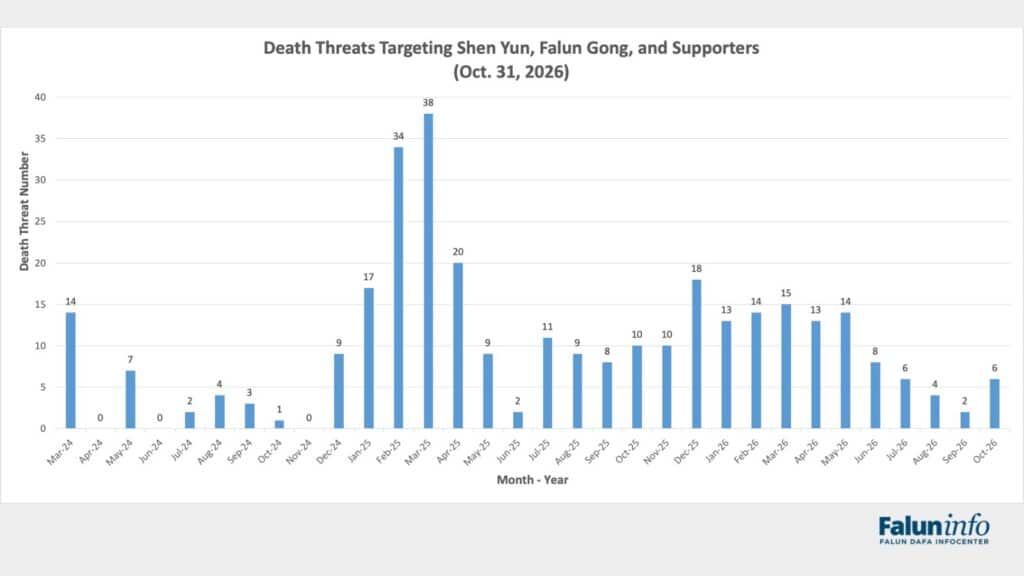
Taken together, these incidents bring the total number of death threats to intimidate Falun Gong practitioners and discourage support for Falun Gong and Shen Yun since March 2024 to 321, according to the Falun Dafa Information Center’s incident tracker updated on October 31, 2026. No physical harm has resulted from those threats to date.
Context and continuing pattern
In FDIC’s assessment, the incidents of August through October share the operational signatures of the campaign documented in previous months, and they appear intended to associate Falun Gong with violence while widening the circle of people and institutions placed under threat.
The senders reused relay points, addresses, and identities seen before. The Shinjuku Cultural Center’s contact form in Tokyo, used on August 26 and 29, also relayed threats documented on May 7–9, June 24, and July 26. The address [email protected], used as a sender in August, received a fabricated FDIC warning on June 6. Dragon Springs’ address was spoofed on August 1 and October 9, as it was in the July 30 threat against the Cincinnati Zoo. The phone number of the State Organs distributor, attached to the October 1 and October 2 messages, appeared in threats documented in 2025 and in June and July 2026; his screening-contact address was used in a threat against State Organs screenings on October 1, 2025, exactly one year before the Vienna message. The address bearing Sheng Xue’s name, used on October 19, appeared in threats in late 2025 and April 2026, and Jie Lijian’s name has been used in threats since 2024. The October 2 threat against the Falun Dafa Association of Taiwan followed a July 26 bomb threat against the same association. Two October 19 threats, one routed through a Taiwanese website and one through FDIC’s form in New York, came from the same IP address.
Threats were routed through government web forms in Vienna and New York City and through a documentary’s screening-request page. Several messages claimed to come from Shen Yun or from “Falun Gong members” while threatening a foreign prime minister, U.S. officials, the White House, public places in Austria, a public library, and Amnesty International Taiwan. This is consistent with the false-flag pattern documented in May and July, in which threats are projected outward from Falun Gong toward unrelated targets, apparently to draw law-enforcement scrutiny onto the community and damage its standing with the public. The chant “Falun Gong hit people” at Joint Base Andrews, at a confrontation where no practitioners were reported present, carried the same false attribution into a physical setting.
The September incidents clustered around Xi Jinping’s September 23–25 visit to the United States: The Epoch Times’ website was attacked two weeks before the visit, and the Toronto and Washington assaults and the Joint Base Andrews chant all occurred between September 22 and 24. The timing is consistent with past efforts to suppress Falun Gong’s visibility during high-profile visits by Chinese leaders.
For more information or assistance, please contact us at [email protected].