
Chinese Men Who Attacked Falun Gong Site in South Korea Left the Country Before Facing Consequences
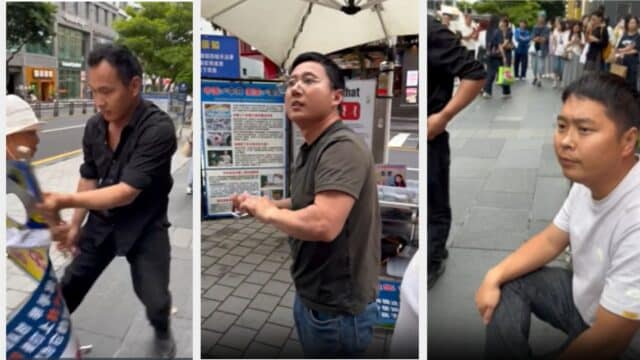
On June 2, 2026, on Jeju Island, South Korea, three Chinese men attacked a Falun Gong information site outside the Shilla Duty Free Store in Yeon-dong district. (Park Dong-Seok)
Updated on October 29, 2026
Correction and update: An earlier version of this article, published June 8, 2026, reported, based on information available at the time, that Korean police arrested the three men at the scene. Park Dong-seok, the organizer of the assembly, said police told him the men were instead taken to Jeju Seobu Police Station under “voluntary accompaniment” (임의동행), a procedure a person is free to decline. The headline and article have been revised accordingly. The article has also been updated with police documentation obtained since publication.
On June 2, 2026, on Jeju Island, South Korea, three Chinese men attacked a Falun Gong information site outside the Shilla Duty Free Store in Yeon-dong district. They destroyed informational display boards, injured at least two practitioners, and threatened others. Police took the men to a nearby station for questioning that evening and released them. Within days, they had left the country.
The attack is the most recent in a documented series of assaults on Falun Gong information sites on Jeju Island. It bears the hallmarks of the Chinese Communist Party’s (CCP) transnational repression: violence on foreign soil against peaceful citizens exposing the CCP’s human rights abuses, carried out with open contempt for local law.
“What happened on Jeju Island is the latest example of the CCP’s transnational repression targeting Falun Gong practitioners and their peaceful activities around the world. In targeting Falun Gong, these attackers allegedly violated Korea’s laws,” said Levi Browde, executive director of the Falun Dafa Information Center. “The Korean police did the right thing by arresting them on the spot. What concerns us is what happens next. Some past cases indicated that the attackers simply flew home before facing any consequences, and that is the outcome Beijing is counting on. We urge Korean authorities to see this case through.”[Editor’s note: this statement was given on June 8, based on initial information that the men had been arrested.]
Obstruction, assault and banner destruction
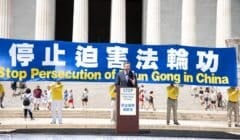
Eight practitioners were conducting the assembly that day—four men and four women, ranging in age from their late 40s to their 70s—according to Park Dong-seok, coordinator of the Jeju chapter of the South Korean Falun Dafa Association. The group had filed a lawful assembly notice and was displaying banners and boards near the duty-free store, a location frequented by Chinese tourists, to inform visitors about the CCP’s persecution of Falun Gong.
The attack began at 6:08 p.m., according to the police record of the incident. Three Chinese men approached the site and began shouting, “Stop doing this!” and “Take it down!” according to Mr. Park, who relayed the account of practitioners who were present. Police later identified the three as two men in their 30s and one in his 40s. The practitioners tried to dissuade them, explaining that the assembly was lawful, but the men kept shouting, “If you don’t take it down, we will smash it.”
One of the men, dressed in black, snatched a picket sign from an elderly female practitioner and slammed it to the ground. The force of the pull knocked her down. He then kicked a standing board that displayed information about the persecution. Male practitioners stepped in to stop him, but he kept kicking the board. Police later recorded 560,000 won in damaged property, listed as office supplies.
A female practitioner pointed to a notice the group had posted in Chinese, citing Korean law: a lawful assembly may not be obstructed, and anyone who does so faces up to three years’ imprisonment or a fine of up to 3 million won. The practitioners had posted the notice after earlier incidents in which Chinese tourists challenged their right to assemble.
The violence then escalated. One of the men struck the left side of a 63-year-old practitioner’s face. He also twisted the hand of a 70-year-old practitioner who tried to intervene, hyperextending the arm and leaving him unable to use his hand properly for about a day.
The two injured practitioners later gave statements to police and submitted medical certificates. According to the copies of those certificates the Falun Dafa Information Center received from the victims, the 63-year-old practitioner had pain in his left upper jaw where he was punched, along with neck pain and an abrasion on his right knee. The 70-year-old practitioner sustained lower-back pain and injuries to the second, third, and fourth fingers of his left hand; doctors applied a splint, noting tenderness and swelling at the middle finger.
Police questioned the men, then let them go
Officers responded to the scene and took the three men to the Jeju Seobu (Western) Police Station, but did so under “voluntary accompaniment” (임의동행) rather than arrest, according to Mr. Park. Under that procedure, police invite a person to come in for questioning, and the person may refuse. The men faced allegations of obstructing a lawful assembly, assault resulting in injury, and property destruction.
Police can still seek a detention warrant (구속영장) after questioning someone brought in this way. In this case they did not, and all three were released. Mr. Park said the reason given was that Korean practice favors investigation without detention (불구속수사).
The 70-year-old practitioner reported the assault to police at 6:57 p.m. that evening. The report was logged under case number 2026-007266 and assigned to the station’s investigation division, according to a certificate of incident facts (사건사고사실확인원) that the Jeju Seobu Police Station issued on June 10 and that the Falun Dafa Information Center has reviewed. The certificate is an administrative record confirming that a report was received and handled; it states on its face that it cannot be used as evidence, and it makes no finding of guilt. It records the complainant’s account that the men demanded he take down placards criticizing the Chinese Communist Party and, when he objected, twisted his wrist and knocked him to the ground. It makes no reference to an arrest.
As the assembly’s organizer, Mr. Park filed a petition with the Jeju Seobu Police Station on June 3, urging a swift and thorough investigation, strict punishment, and—if the suspects posed a flight risk—an exit ban. The petition argued that the attack was not a chance altercation but a collective, organized crime: the men acted in concert, threatened participants, and were seen trying to summon additional people. It also warned that foreign perpetrators in past Jeju and Seoul cases had left the country before they could be identified or punished, making it impossible for victims to recover damages.
On June 5, Mr. Park said he had confirmed with police that they intend to forward the case to prosecutors.
Update: the suspects left South Korea
Police questioned the injured practitioners the day after the attack and said they would call the three men back in, Mr. Park told the Falun Dafa Information Center in an interview on August 31. Before that could happen, the men had already left the country.
Police referred the case to prosecutors, Mr. Park said, but told him they had been unable to secure the suspects’ presence because the men had departed. Referral to prosecutors (송치) is not an indictment; prosecutors decide whether to bring charges. The Falun Dafa Information Center has requested documentation of the referral and will update this article when it is available.
If any of the three enters South Korea again, Mr. Park said, they could face arrest or a fine. He does not expect them to return.
Mr. Park said he suspects the officer handling the case chose voluntary accompaniment over arrest to avoid a matter that would become complicated. He stressed that this is his own speculation and that he has no evidence for it.
A recurring pattern
The June 2 assault did not occur in isolation. Falun Gong practitioners and rights groups have documented a sustained pattern of violence and intimidation against the community on Jeju Island and around the world.
Between October and November 2023, seven separate attacks on Falun Gong information booths took place on the island, according to Minghui. In the final incident, a Chinese man kicked over poster boards, destroyed posters, and attempted to set them on fire. He was arrested and indicted. The South Korean Falun Dafa Association said at the time that the attacks were not coincidental but organized by the CCP, noting that the perpetrators selectively destroyed boards on specific topics, including forced organ harvesting.
The Center has documented physical assaults on practitioners at information sites in London, New York, and other cities, alongside harassment, surveillance, and pressure campaigns directed by the CCP against practitioners living abroad.
Falun Gong, also known as Falun Dafa, is a spiritual practice rooted in the principles of truthfulness, compassion, and forbearance. The CCP launched a campaign to eradicate the practice in 1999. Practitioners in China have since been subjected to mass detention, torture, and forced organ harvesting. The Falun Gong practitioners on Jeju Island maintain their information site so that Chinese visitors can learn facts that are censored inside China.
Call to action
The Falun Dafa Information Center calls on:
- South Korean prosecutors to carry this case forward despite the suspects’ departure, and to make the disposition public.
- South Korean police and immigration authorities to ensure the three are identified if they return, and in future cases to weigh flight risk from the first hour. Across multiple Jeju cases, foreign suspects have now left the country before questioning could be completed.
- The South Korean government to investigate whether the repeated attacks on Falun Gong sites are coordinated, and to safeguard the constitutional rights of assembly and expression for all people on Korean soil.
- Governments and international bodies to recognize attacks of this kind as transnational repression and to hold the CCP accountable for exporting its persecution abroad.
- Members of the public and the media to report on the incident and stand with the peaceful practitioners who were attacked for telling the truth.