


A 25-Year Atrocity
Forced Organ Harvesting
in China
A growing body of evidence indicates that Chinese hospitals have been colluding with the country’s police in a nefarious scheme known as “organ harvesting.” They hold prisoners of conscience against their will, often illegally, examine them for organ compatibility, and then systematically remove their healthy organs to supply transplants for a booming organ transplantation industry.
Since 1999, the Chinese Communist Party has detained millions of Falun Gong practitioners in prisons, labor camps, and “transformation” centers. Beginning in the early 2000s, China’s organ transplantation industry underwent an explosive expansion that cannot be explained by voluntary donation or executed-prisoner data. Hospitals openly advertised waiting times of as little as two weeks for matched organs — figures unparalleled anywhere else in the world, and consistent only with a population of pre-screened, expendable donors.
That population, decades of investigation has established, has been detained prisoners of conscience — principally Falun Gong practitioners, and more recently Uyghurs. They were medically tested in custody, then killed and their organs sold. The findings below are drawn from peer-reviewed medical journals, an independent people’s tribunal chaired by the prosecutor of Slobodan Milošević, twelve United Nations Special Rapporteurs, a survey of former Falun Gong detainees, and binding laws in 14 jurisdictions worldwide.
Latest news
New report · ETAC · Oct 20, 2026
Red Flags, Part 1: The Party’s Hold on China’s Medical Profession and Transplant Sector
The first in a new ETAC investigative series on signs of ongoing transplant abuse in China, led by researcher Sarah Cook.
Key Facts
60K–90K
Transplants per year in China
(China Tribunal estimate)
~2 weeks
Advertised waiting time for a matched organ in China — vs. months or years elsewhere
1 in 2
Former Falun Gong detainees surveyed were subjected to blood tests or suspicious medical exams in custody (2026)
56
Chinese hospitals where surgeons’ own published papers describe removing organs before brain death (2022)
12
UN Special Rapporteurs “extremely alarmed” by forced organ harvesting allegations (2021)
8
Countries with binding national laws against organ trafficking or transplant tourism
How we know
The case is built not on a single source but on the convergence of independent lines of evidence — medical, statistical, testimonial, forensic, and governmental. Each of the seven categories below has been independently corroborated.
01 Whistleblowers from inside the system
In 2001, Dr. Wang Guoqi testified before the U.S. House on organ procurement from prisoners executed by gunshot — sometimes before death. Former Xinjiang surgeon Dr. Enver Tohti has testified that in 1995 he was ordered to remove organs from a still-living prisoner. In 2024, the first known survivor of a forced organ harvesting attempt came forward publicly.
02 Transplant volumes that have no explanation
By the mid-2000s, China was performing tens of thousands of transplants per year. Voluntary donation rates inside China were near zero, and executed-prisoner totals were nowhere near sufficient. The arithmetic forced a question that Beijing has never satisfactorily answered: where are the organs coming from?
03 Waiting times that defy biology
Chinese hospitals openly advertised — often in English, to attract transplant tourists — matched-organ waiting times of as little as 4 to 14 days. Such times are clinically impossible without a pre-screened pool of living donors whose organs can be removed on demand.
04 Medical testing of detained Falun Gong — and only Falun Gong
Across labor camps and prisons throughout China, Falun Gong detainees were singled out for blood draws, tissue typing, ultrasound, and X-ray exams. Other prisoners were not. Survivors’ accounts of these procedures, taken over two decades, are remarkable for their consistency.
05 Undercover calls to Chinese hospitals
Investigators recorded telephone calls in which Chinese transplant doctors confirmed availability, short waiting times, and — on tape — the use of Falun Gong practitioners as donors. The recordings are reproduced in the China Tribunal’s final judgment.
06 Peer-reviewed forensic analysis
In 2022, the American Journal of Transplantation published Robertson and Lavee’s computational analysis of 2,838 Chinese-language transplant papers. The authors identified 71 cases at 56 hospitals in which brain death could not have been properly declared before procurement — cases where, as the paper concludes, the heart’s removal must have been the cause of death.
07 Independent investigations
Canadian Crown prosecutor David Kilgour and human rights lawyer David Matas (Nobel Peace Prize nominees, 2010); journalist Ethan Gutmann (The Slaughter, 2014); and the International Coalition to End Transplant Abuse in China have each, in independent multi-year investigations, reached the same conclusion: state-organized killing of prisoners of conscience for organs is real, large-scale, and ongoing.
08 Governmental confirmation
The U.S. Congress, the European Parliament, the Australian Parliament, the U.K. Parliament, the Canadian Parliament, twelve UN Special Rapporteurs, and the U.S. Congressional-Executive Commission on China have all formally examined the evidence and acted on its findings.
The China Tribunal
In 2018, the International Coalition to End Transplant Abuse in China commissioned an independent people’s tribunal in London to examine, in formal legal proceedings, the question of whether forced organ harvesting from prisoners of conscience had been — and was still being — committed in China.
The tribunal’s seven members were chosen from outside the Falun Gong community. They included Sir Geoffrey Nice KC, lead prosecutor of Slobodan Milošević at the UN International Criminal Tribunal for the former Yugoslavia, as chair; Professor Martin Elliott, paediatric transplant surgeon at University College London; Professor Arthur Waldron, historian of China at the University of Pennsylvania; and the Iranian human rights lawyer Shadi Sadr, among others. None of the members were Falun Gong practitioners. All served pro bono.
Over more than a year, the tribunal heard testimony from over fifty fact and expert witnesses — including journalists, doctors, researchers, and former Chinese detainees — and reviewed hundreds of pages of written submissions. Its proceedings were open to the press. On June 17, 2019, the tribunal issued its short-form judgment. On March 1, 2020, it issued its full Final Judgment.
Beyond reasonable doubt
“Forced organ harvesting has been committed for years throughout China on a significant scale and … Falun Gong practitioners have been one — and probably the main — source of organ supply… The Tribunal has had no evidence that the significant infrastructure associated with China’s transplantation industry has been dismantled and absent a satisfactory explanation as to the source of readily available organs concludes that forced organ harvesting continues till today.”
— The China Tribunal, Final Judgment, 1 March 2020
The tribunal further concluded that the People’s Republic of China and certain of its officials are guilty of crimes against humanity against Falun Gong practitioners, including murder and torture. The tribunal’s 562-page judgment, with all supporting witness statements, is publicly available.
Global legislative action
Governments and legislatures around the world have acted on the evidence. As of May 2026, eight countries have enacted binding national laws criminalizing organ trafficking or transplant tourism — many citing Falun Gong practitioners by name — and six U.S. states have followed.
Binding national laws
| Year | Jurisdiction | Measure |
|---|---|---|
| 2008 | Israel | Organ Transplant Act. Within three years, transplant tourism from Israel to China stopped completely. |
| 2010 | Spain | Criminal Code Article 156 bis. 6–12 years for trafficking vital organs; recipients face equivalent penalties. |
| 2015 | Taiwan | Human Organ Transplantation Act Amendment. Bans use of organs from executed prisoners; prohibits transplant tourism. |
| 2016 | Italy | Law n. 236/2016. 3–12 years imprisonment; Senate debate named Falun Gong practitioners as principal victims. |
| 2017 | Norway | Transplantation Act Amendment. Ratifies Council of Europe Convention against Trafficking in Human Organs. |
| 2019 | Belgium | Van Peel Law. Passed 134–0. First in Europe to embed cross-reference to the 2013 European Parliament resolution naming Falun Gong as primary victims. |
| 2022 | United Kingdom | Health and Care Act 2022, ss. 170–171. Criminalizes commercial organ tourism for UK residents extraterritorially. |
| 2022 | Canada | Bill S-223. Passed unanimously, 324–0. Extraterritorial criminal jurisdiction; bars foreign nationals involved in organ trafficking from entering Canada. |
U.S. state laws
| Year | Jurisdiction | Measure |
|---|---|---|
| 2023 | Texas — SB 1040 | First U.S. state law targeting forced organ harvesting from China; names Falun Gong practitioners, Uyghurs, Tibetans, and House Church Christians as victims. |
| 2024 | Utah — SB 262 | Prohibits health insurance coverage of transplants performed in or sourced from China. Passed both chambers unanimously. |
| 2024 | Idaho — HB 670 | End Organ Harvesting Act. Prohibits health insurance coverage and restricts genetic-sequencing technologies from adversary nations. |
| 2025 | Tennessee | Genomic Security and End Organ Harvesting Act. Passed unanimously (90–0 House; 27–0 Senate). $100,000 fine per violation. |
| 2025 | Arkansas — SB 311 | End Organ and Genomic Harvesting Act (Act 772). Prohibits insurance coverage of transplants using organs from China or other countries engaged in forced organ harvesting. Passed 34–0 Senate; 81–11 House. $10,000 fine per violation. |
| 2025 | Arizona — HB 2109 | End Organ Harvesting Act. Prohibits Medicaid and private insurance coverage of transplants from China or Hong Kong. |
U.S. Federal action
| Year | Jurisdiction | Measure |
|---|---|---|
| 2016 | U.S. House of Representatives | H.Res. 343 expressing concern over “systematic, state-sanctioned organ harvesting” from prisoners of conscience. |
| 2023 | U.S. House of Representatives | H.R. 1154, Stop Forced Organ Harvesting Act, passed 413–2. |
| 2025 | U.S. House of Representatives | H.R. 1540, Falun Gong Protection Act, passed by voice vote. Requires sanctions on individuals who facilitate forced organ harvesting in China. |
Key coverage
For more than a decade, the world’s leading investigative outlets and reference institutions have documented forced organ harvesting in China. The pieces below are starting points for readers, journalists, and policymakers.
Reuters · June 17, 2019
China Forcefully Harvests Organs from Detainees, Tribunal Concludes
Wire-service report on the China Tribunal’s short-form judgment, including the “beyond reasonable doubt” finding.
The Guardian · June 17, 2019
China is Harvesting Organs from Detainees, UK Tribunal Concludes
Owen Bowcott’s detailed account of the tribunal’s findings and Sir Geoffrey Nice’s remarks.
NBC News · June 18, 2019
China Forcefully Harvests Organs from Detainees, Tribunal Concludes
A U.S. broadcast outlet’s coverage of the tribunal’s judgment and its implications for U.S.–China policy.
American Journal of Transplantation · April 2022
Execution by Organ Procurement: Breaching the Dead Donor Rule in China
Peer-reviewed paper by Matthew P. Robertson and Jacob Lavee that uses computational analysis of 2,838 Chinese-language transplant papers to identify 71 cases in which the heart’s removal must have been the cause of death.
UN Office of the High Commissioner for Human Rights · June 14, 2021
China: UN Human Rights Experts Alarmed by ‘Organ Harvesting’ Allegations
Joint statement by twelve UN Special Procedures mandate holders calling on China to allow independent monitoring of the allegations.
The Diplomat · August 2024
First Known Survivor of China’s Forced Organ Harvesting Speaks Out
First-person account by Cheng Pei Ming, who survived an organ procurement attempt while detained in a Chinese hospital.
Tom Lantos Human Rights Commission · May 12, 2022
Forced Organ Harvesting in China: Examining the Evidence
U.S. congressional hearing featuring testimony from Sir Geoffrey Nice KC, Matthew Robertson, Ethan Gutmann, and Dr. Enver Tohti.
Take action
Members of the public, faith leaders, doctors, lawyers, and policymakers all have a role to play in ending forced organ harvesting. The most effective single thing you can do today is sign and share the petition; the most effective long-term thing is to make sure your representatives know this is a constituent priority.
Latest news
New report · ETAC · Oct 20, 2026
Red Flags, Part 1: The Party’s Hold on China’s Medical Profession and Transplant Sector
The first in a new ETAC investigative series on signs of ongoing transplant abuse in China, led by researcher Sarah Cook.
Featured book
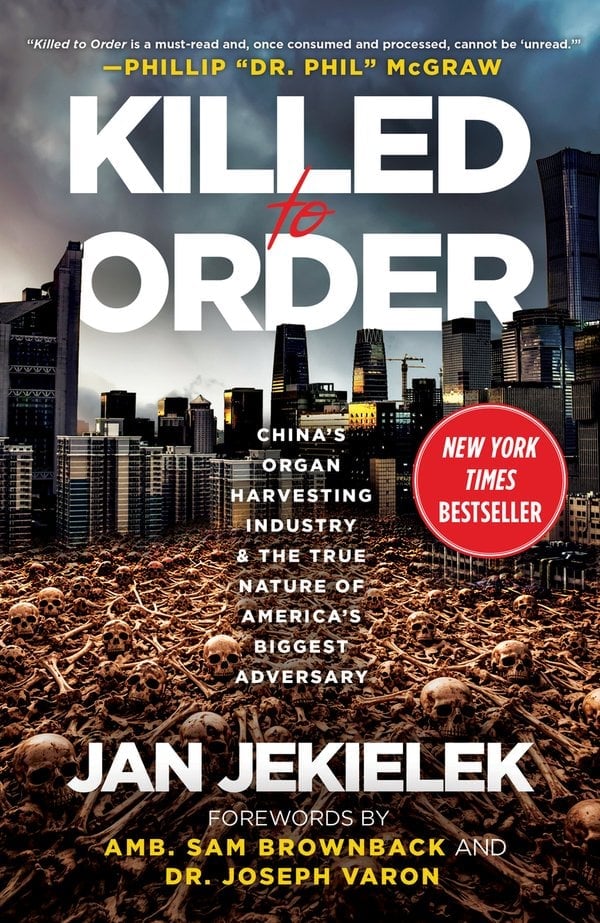
Killed to Order
China’s Organ Harvesting Industry & the True Nature of America’s Biggest Adversary — by Jan Jekielek (Skyhorse, 2026)
New York Times bestseller
#1 Amazon: Asian politics
#1 Amazon: Communism & Socialism
A senior editor at The Epoch Times distills two decades of evidence into a single accessible volume — from whistleblower testimony to peer-reviewed forensics — with a foreword by former Ambassador-at-Large for International Religious Freedom Sam Brownback and prefatory remarks by Dr. Joseph Varon.
“An exposé of China’s unethical, immoral, and corrupt systemic practice of harvesting ‘organs to order.’”
— Phil McGraw
“Difficult to read — not because it is poorly written, but because it is a very well-written overview of how a modern state can commit murder on this scale.”
— The Epoch Times (review)
“A book that can help delegitimize China’s communist regime and bring about its end.”
— Hon. Sam Brownback, foreword

Join Our Newsletter
Sign up today and join our monthly email list.