
Falun Gong Practitioners and Allies Call for an End to the Persecution as Xi Visits Washington
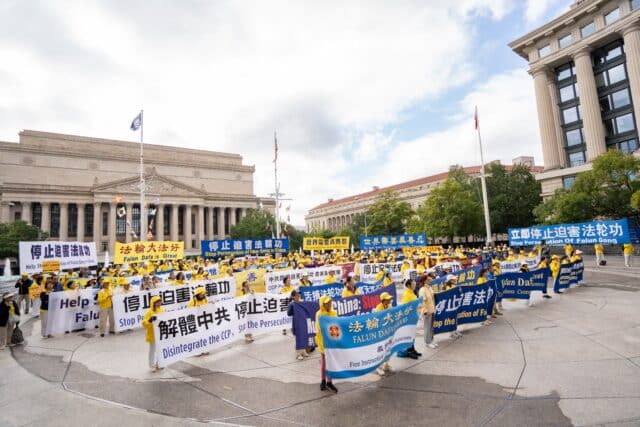
Falun Gong practitioners rally at the U.S. Navy Memorial Plaza in Washington on Sept. 24, 2026, calling for an end to the Chinese Communist Party’s persecution during Chinese leader Xi Jinping’s state visit. (Photo: Samira Bouaou/The Epoch Times)
On Sept. 24, as President Trump hosted Chinese leader Xi Jinping at the White House, hundreds of Falun Gong practitioners from across the United States gathered less than a mile away at the U.S. Navy Memorial Plaza. They came to call for an end to the Chinese Communist Party’s (CCP) 27-year persecution of the spiritual practice.
The day opened with a rally of more than 20 speakers. In the afternoon, practitioners demonstrated Falun Gong’s exercises on the plaza, where the Art of Zhen Shan Ren International Exhibition was also on display. At dusk, they held a candlelight vigil for those who have lost their lives in the persecution.
Organizers put four requests to the Trump administration. They asked President Trump to publicly call on Xi to end the persecution and the forced harvesting of organs from Falun Gong practitioners and other prisoners of conscience. They urged the administration to stop the CCP’s transnational repression of Falun Gong on American soil. They also called for the release of imprisoned practitioners who have relatives in the United States. Finally, they asked that Secretary of State Marco Rubio prioritize sanctions on CCP officials directly responsible for the detention, torture, and killing of practitioners.
A broad coalition of voices
Falun Gong practitioners organized the rally, but many of the more than 20 speakers came from outside the community. They included a member of Congress, a former State Department official, leaders of religious freedom and human rights groups, and Uyghur, North Korean, and Vietnamese American advocates.
Nina Shea, director of the Hudson Institute’s Center for Religious Freedom, described the gathering as part of “a new movement” of solidarity with Falun Gong and other persecuted believers in China. “I myself am a Roman Catholic,” she said, noting that a Uyghur Muslim had spoken just before her.
Later in the program, several practitioners who had been tortured in Chinese custody spoke about their experiences, among them the only known survivor of forced organ harvesting. Two speakers talked about their parents, who are still imprisoned in China for practicing Falun Gong.
Pressing Washington to act
Rep. Pat Ryan (D-NY), whose district is home to many Falun Gong practitioners, said it was “a disgrace to our values as Americans” that Xi was “even allowed to be here on our soil,” let alone “honored and welcomed with a red carpet,” given the CCP’s “systemic practice of organ harvesting.” A co-sponsor of the House-passed Falun Gong Protection Act, Ryan said Congress maintains “bipartisan support for religious freedom” and expressed hope that the pressure would lead President Trump to “publicly join in our outcry.”
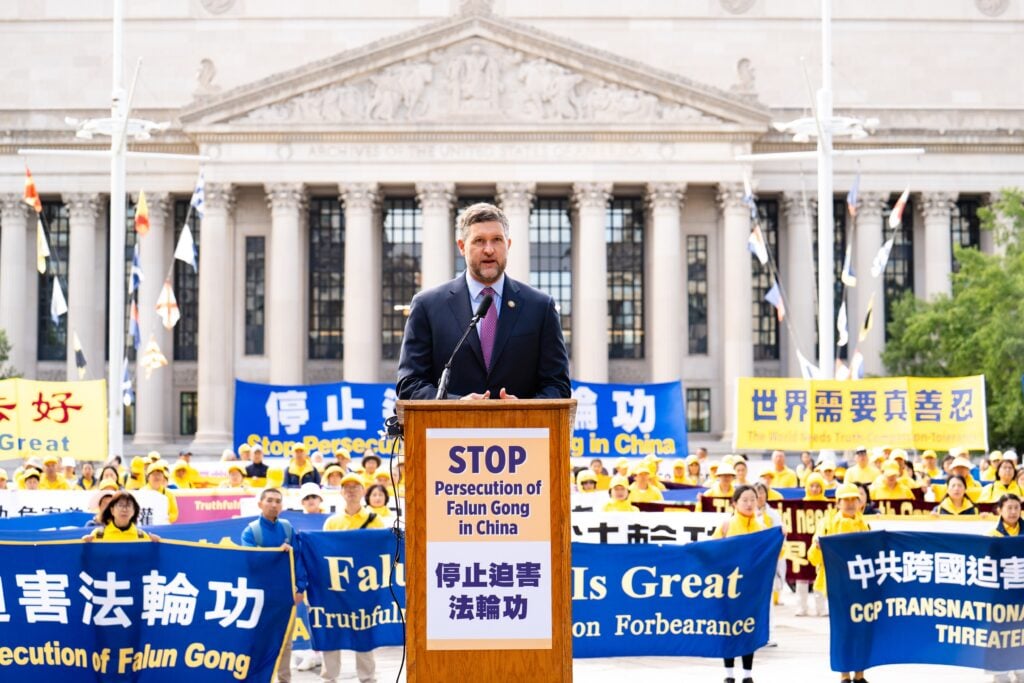
Robert Destro, a law professor at the Catholic University of America who served as assistant secretary of state for democracy, human rights, and labor in the first Trump administration, said Falun Gong is “so important to the discussion between the United States and China” because the movement “sees the Chinese Communist Party for what it is.” Pointing to a banner behind him, he said the principles of Truthfulness, Compassion, and Forbearance “should guide the way in which America does its foreign policy.”
David Trimble, president of the Religious Freedom Institute, called on Xi to end the persecution immediately and rejected the idea that religious freedom is a sideshow to trade and security talks. “This conversation can never be marginalized,” he said. “It must be prioritized.”
Jan Jekielek, author of Killed to Order and host of American Thought Leaders, explained how the CCP’s campaign against Falun Gong created a vast pool of prisoners of conscience who could be killed for their organs on demand. Today, he said, “if you have enough money, you can go to China and get a new heart in two weeks’ time.” He urged U.S. leaders to treat human rights as leverage over Beijing, one “that we’ve kind of forgotten about.”
Louisa Greve, an advisory board member of the International Coalition to End Transplant Abuse in China, urged the Senate to act on forced organ harvesting legislation already passed by the House. “If we’re going to host Xi Jinping, we better pass more bills that will strengthen American policy,” she said. She also noted that Texas, followed by Arizona, Idaho, Utah, and Tennessee, has passed laws to stop insurers from covering such transplants.
Solidarity across communities
Rushan Abbas, founder and executive director of the Campaign for Uyghurs, said her sister, Dr. Gulshan Abbas, a retired physician, has been imprisoned since September 2018. Her arrest came six days after Rushan spoke on a public panel about China’s mass detention of Uyghurs. The anguish of families waiting for word of an imprisoned loved one, she told the crowd, “needs no translation.”
Omer Kanat, executive director of the Uyghur Human Rights Project, said many tactics now used against Uyghurs, including forced organ harvesting, were first tested on Falun Gong practitioners. He described the choice that CCP pressure forces on diaspora communities. “Do we speak freely or do we protect our families?”
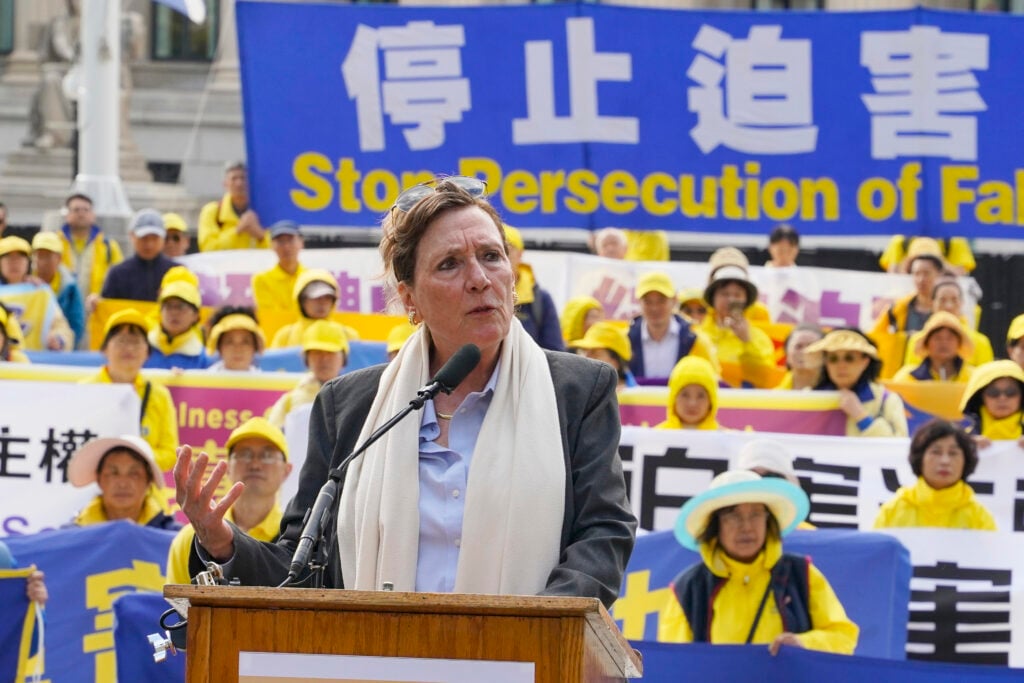
Suzanne Scholte, president of the Defense Forum Foundation, recalled first hearing about Falun Gong in 1999 from South Korean pastors and North Korean refugees held in Chinese detention centers. They told her the practitioners detained alongside them were “housewives and students” who “had no reason to be in the detention centers.”
Greg Scarlatoiu, executive director of the Committee for Human Rights in North Korea, said that 27 years after the CCP set out to eradicate the practice, “Falun Gong has survived.” Chen Guangcheng, the blind Chinese human rights activist, spoke through an interpreter. He called the CCP “the enemy of mankind” and said it was sad to see its leader received as a “VIP guest” in the United States. He urged American officials to deal with Beijing “from a position of strength.”
Survivors and families speak
Mr. Cheng Peiming, the only known survivor of forced organ harvesting, said parts of his lung and liver were cut out while he was imprisoned for practicing Falun Gong, leaving a 35-centimeter scar. “I cannot catch my breath when I walk. I cannot catch my breath when I try to sleep,” he said through an interpreter. He ended with a plea. “Give me back my lung. Give me back my liver.”
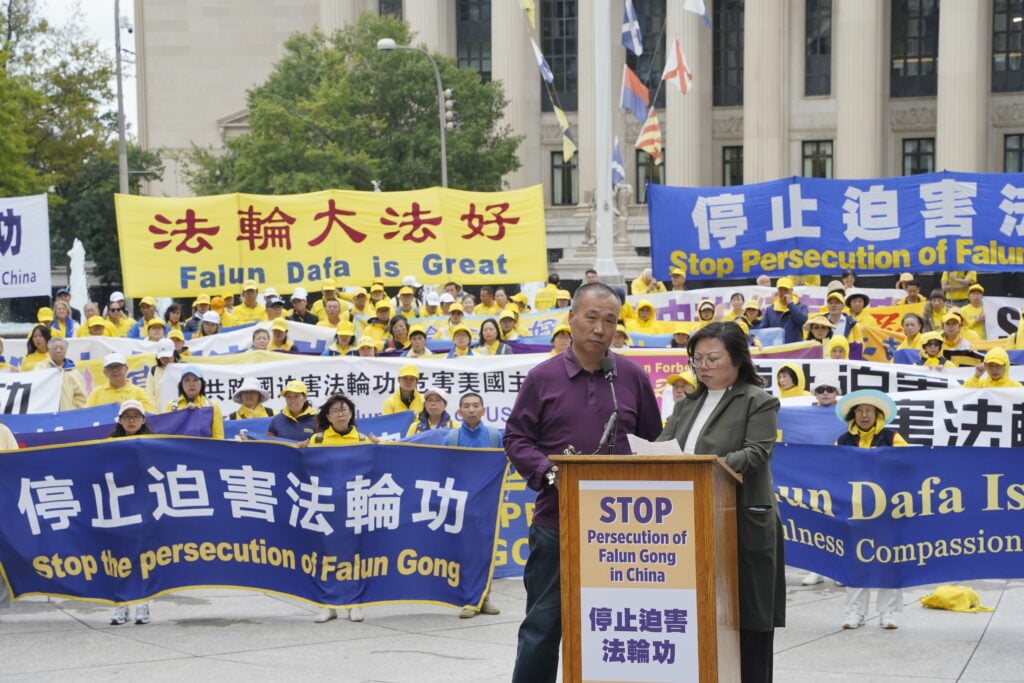
Alisa Zhou, a Maryland resident, spoke for her mother, Ms. Wang Youmei, one of 17 practitioners arrested in Wuhan on April 15. It was Ms. Wang’s fifth arrest since 1999, and she remains in the Wuhan No. 1 Detention Center. Alisa said her mother once saved her life by refusing to abort her, a second child under China’s one-child policy. “Now it is my turn to stand for her,” she said.
Zhou You, a software engineer, said his father, Mr. Zhou Deyong, was arrested in Shandong Province in 2021 and sentenced to eight years in prison. Zhou You’s son was born after the arrest, and the boy’s grandfather has never seen a photo of him. “If the CCP cannot obey its own law, how could we expect it to obey international law?” Zhou You asked.
Other survivors described what they endured in custody. A former real estate executive said police beatings broke his back and both of his feet. A statement read on behalf of another survivor recounted her husband’s five imprisonments, including a 10-year sentence.
Art exhibition and candlelight vigil
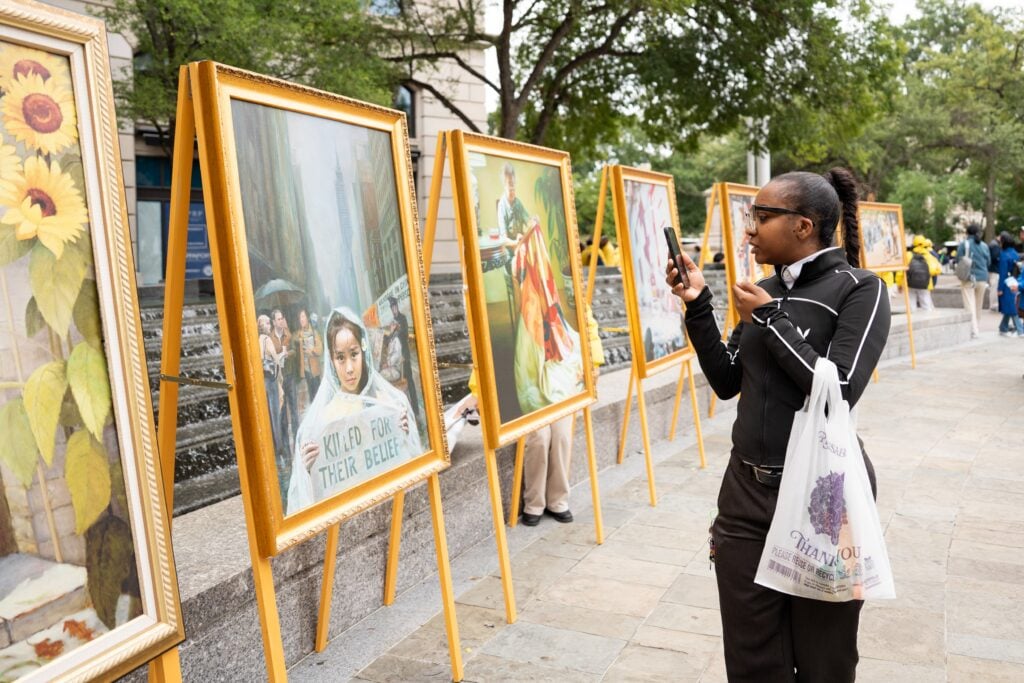
The plaza also hosted the Art of Zhen Shan Ren International Exhibition, named for the Chinese words for Truthfulness, Compassion, and Forbearance. Its paintings, most of them in classical oil, portray both the spiritual themes at the heart of the practice and the persecution practitioners have endured in China. The exhibition debuted in 2004 at the Rayburn House Office Building on Capitol Hill and has since traveled to more than 50 countries.
In the afternoon, practitioners performed Falun Gong’s five sets of gentle exercises together on the plaza.
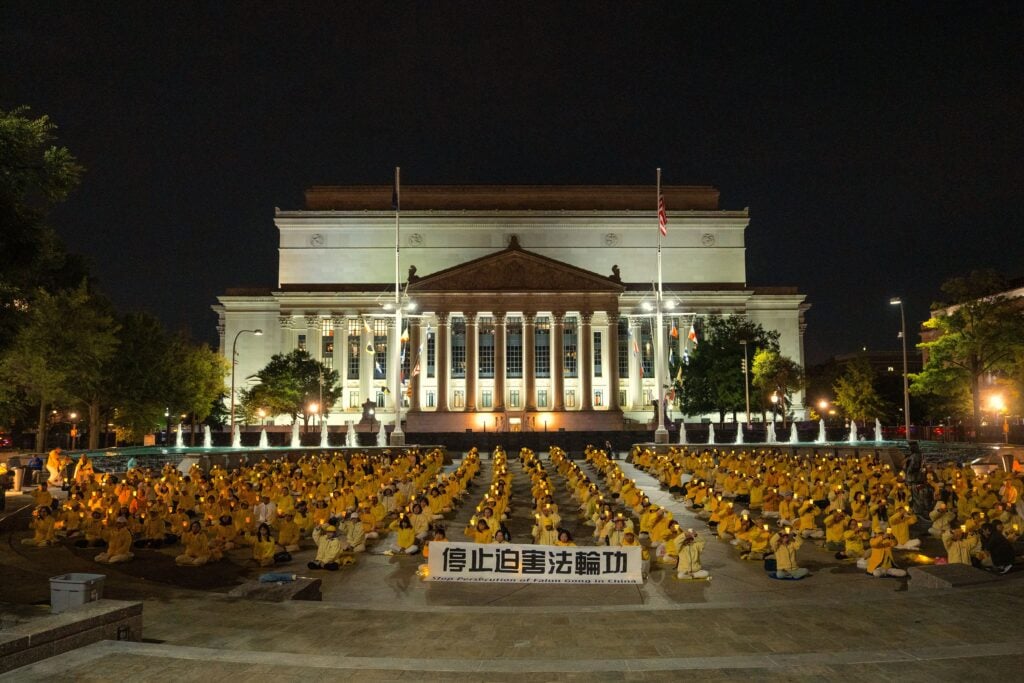
As evening fell, practitioners who had traveled from across the country sat in silent meditation on the plaza, each holding a candle, in memory of those who have died in the persecution since 1999. Minghui.org, a website that documents the persecution, has confirmed more than 5,000 such deaths. The true toll is believed to be far higher, since information from inside China is tightly controlled.