
Falun Gong Practitioners Parade in Brooklyn Under the Shadow of Beijing’s Reach
Two women whose cases appear in a new nationwide survey on CCP transnational repression marched again on Eighth Avenue. One of them returned to the spot where she was assaulted two years ago.

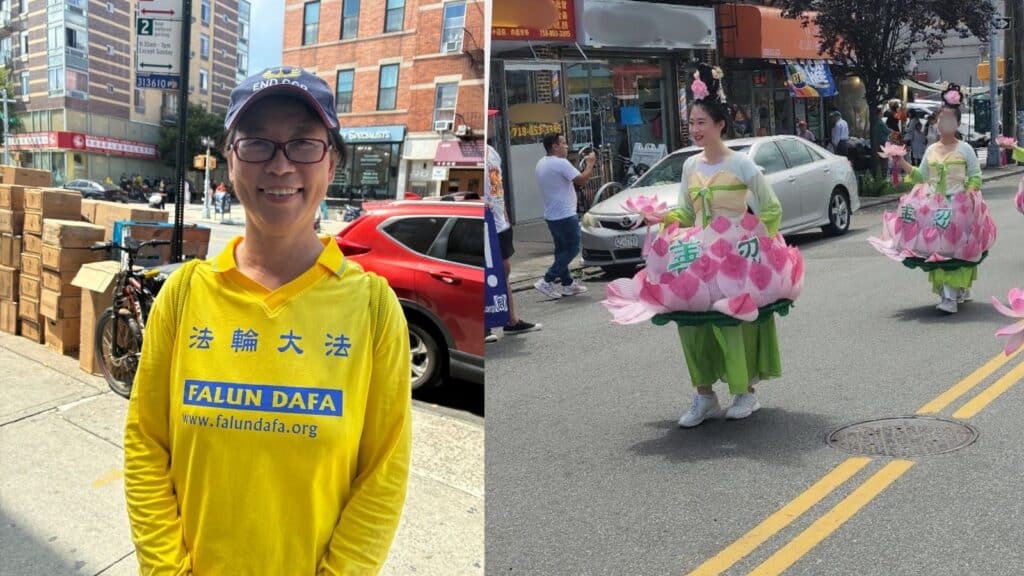
Falun Gong practitioners hold a parade at the Eighth Avenue in Brooklyn, New York on August 23, 2026. (Photo: Lotus team)
BROOKLYN, N.Y. — The parade moved down Eighth Avenue on Sunday afternoon in a long line of small contingents. Lily walked alongside the procession in a yellow jacket. Her job was the one she had the last time she stood on this street: keep the line orderly, watch the crowd.
The last time, a man rushed the line and struck her. Twice.
That was September 2024. On Aug. 23, 2026, she was back in the same role on the same avenue. About a thousand practitioners marched from 66th Street down to 43rd Street, through Brooklyn’s largest Chinese neighborhood, carrying Mid-Autumn Festival greetings to the shops and families along the way.
“Today I came back to this parade, again as a volunteer,” she said. “I feel proud. I feel honored. There is nothing better than this.”
Somewhere else in that line was a woman who will be called Jing here. Last August, a man tried to burn down the information booth she was staffing in Flushing.
Both women are among the 1,080 people who answered a nationwide survey the Falun Dafa Information Center ran between September 2025 and March 2026. The findings came out in June under the title Americans Targeted by Beijing. Lily’s assault is written up there as a case study. So is what happened to Jing in Flushing.
They were interviewed by the Center on Sunday. The attacks, they said, had changed nothing about their plans.
“Evil never overcomes the righteous”
The marchers that September day were easy to pick out. They wore yellow shirts and jackets that read “Falun Dafa.”
A man came into the procession looking for them. He went after the children first. He cursed at the women. He spat. He reached Lily and hit her, then circled back and hit her again. Others were attacked on the street afterward. Two days later, an email arrived claiming responsibility for all of it. Local law enforcement called it a hate crime.
“A series of actions like that is absolutely not a coincidence,” Lily said.
She had never seen the man before. He was large, she remembers, and he moved through the crowd with purpose. She was wearing a Falun Dafa T-shirt. Everyone around her was a practitioner. That was the point.
What stays with her is not the blow. It is what she decided in the seconds afterward, which was to finish the march.
“Even when he attacked me for no reason, right in the middle of the parade, I did not give in to fear,” she said. “Evil does not overcome the righteous. Evil has never once defeated justice.”
Her case is one of 92 instances of physical assault and property damage the survey documents between 2020 and 2025. They span 15 states. New York and California account for most of them.
The count she keeps
Asked what had changed in two years, Lily did not talk about her own case. She talked about arithmetic.
The House has now passed the Falun Gong Protection Act twice, first in June 2024 and again in 2025. On June 17 of this year, the Senate Foreign Relations Committee advanced a separate and broader bill, the Falun Gong and Victims of Forced Organ Harvesting Protection Act, which extends the same protections to all victims of forced organ harvesting in China. It now goes to the full Senate. If it becomes law, it would require an annual accounting of China’s organ transplant system and open the door to visa bans and asset freezes.
Parade organizers offered two more figures. Nearly 460 million Chinese people have now publicly renounced their ties to the Communist Party and its youth organizations. The global petition calling for the Party’s end has passed 5.38 million signatures.
“The situation has changed enormously,” she said. “The more the Party does, the more people understand the difference between good and evil. People with a conscience will not go on believing lies. It only wakes them up faster.”
In her account, the violence works against the people who ordered it.
“Falun Dafa teaches people to live by Truthfulness, Compassion and Tolerance,” she said. “To be good people, and then better ones. Those who act as the Party’s proxies cannot frighten practitioners. What they do is expose the Party’s evil face to the whole world.”
Lighter, tent, and black car
It was August 2025. Jing was working an information booth in Flushing.
A man in his thirties began mocking her. He stopped people on the sidewalk and got them shouting at her too. Then he went for the leaflets. He grabbed at a whole stack. Jing and two other practitioners moved in, and he came away with a single sheet, which he tore up while pacing and yelling nearby.
He walked off. A few minutes later he was back, holding a lighter. He tried to set the tent on fire.
Jing warned him she would call the police.
“Go ahead, report me,” he said.
He crossed the street to a black car and got in on the passenger side. Someone else was at the wheel. That person has never been identified.
The report files Jing’s case under threats of violence. There are 86 such instances in the survey data, affecting 80 people. More than half occurred in 2025.
On Sunday she was marching. She did not say much about it.
“I’m glad to be in this parade today,” she said. “What happened cannot stop me from doing things like this. I’ll keep doing what’s right. Telling people that Falun Dafa is good. Telling them it’s the Communist Party doing the bad things.”
Fear, and marching anyway
Nearly 60 percent of respondents—645 people—reported some form of transnational repression since 1999. But 521 of them, 48 percent, had an incident in just the past four years. Reported cases in 2025 ran more than ten times higher than in 2020.
Harassment was the most common tactic, with 158 documented instances across 12 states. Most of it happened at parades, rallies and information booths. In other words, at events like Sunday’s.
The Information Center has separately logged 298 violent threats against practitioners, Shen Yun and their supporters since March 2024.
The survey also asked people how they feel. More than 60 percent are uneasy about how far Chinese surveillance reaches inside the United States. Roughly a third, 337 people, said they feel unsafe or very unsafe. The rate is far higher among those who were persecuted in China before coming here: 55 percent of them feel unsafe.
And yet more than 57 percent said they still feel safe enough to practice openly and speak up. The fear is real, and so is the decision to march anyway. That is roughly the shape of Sunday afternoon on Eighth Avenue.
The procession broke up near 43rd Street. A man and his young daughter walked over to one of the band’s tuba players, Alex. The girl had loved the music, her father explained. She wanted to hear it up close.
Alex played the opening bars of “Falun Dafa Is Great.” Then he told them a little about the practice, the exercises, the three words the banners kept repeating. The girl listened to the horn. Her father took a flyer.
“I love the principles of Truthfulness, Compassion and Tolerance,” the father said.