
Falun Gong Spokesperson Testifies at CECC Hearing Ahead of Xi Jinping’s Visit to Washington
Erping Zhang urged the Trump administration to raise the persecution of Falun Gong with Xi, and asked Congress to confront Beijing’s weaponization of the U.S. legal system
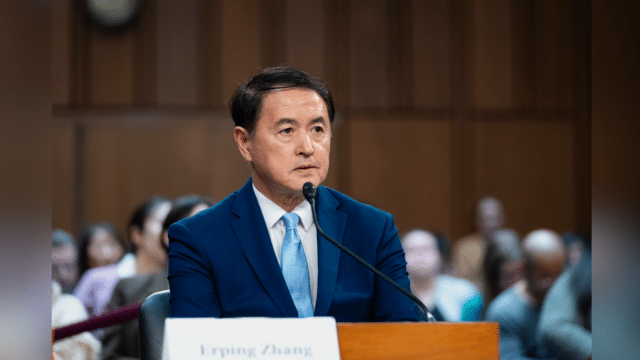
Falun Gong spokesperson Erping Zhang at a Sept. 22 CECC hearing on prisoners of conscience ahead of Xi Jinping's visit to Washington. (Madalina Kilroy/The Epoch Times)
Erping Zhang, spokesperson for Falun Gong, testified before the Congressional-Executive Commission on China (CECC) on September 22, telling lawmakers that the Chinese Communist Party’s (CCP) campaign to eradicate the spiritual practice remains a top priority for the regime, and that the persecution has followed practitioners onto American soil.
The hearing, titled “The Faces of Repression: Prisoners, Families, and Communities Targeted by the CCP,” was held one day before Chinese leader Xi Jinping’s state visit to Washington. Lawmakers and witnesses used the occasion to urge President Trump to raise the cases of prisoners of conscience directly with Xi.
“Today we appeal to Xi Jinping to release women and men of conscience and goodness as a tangible, good-faith expression of goodwill, benevolence, respect and strength,” said Rep. Chris Smith (R-N.J.), co-chair of the CECC, who presided over the hearing.
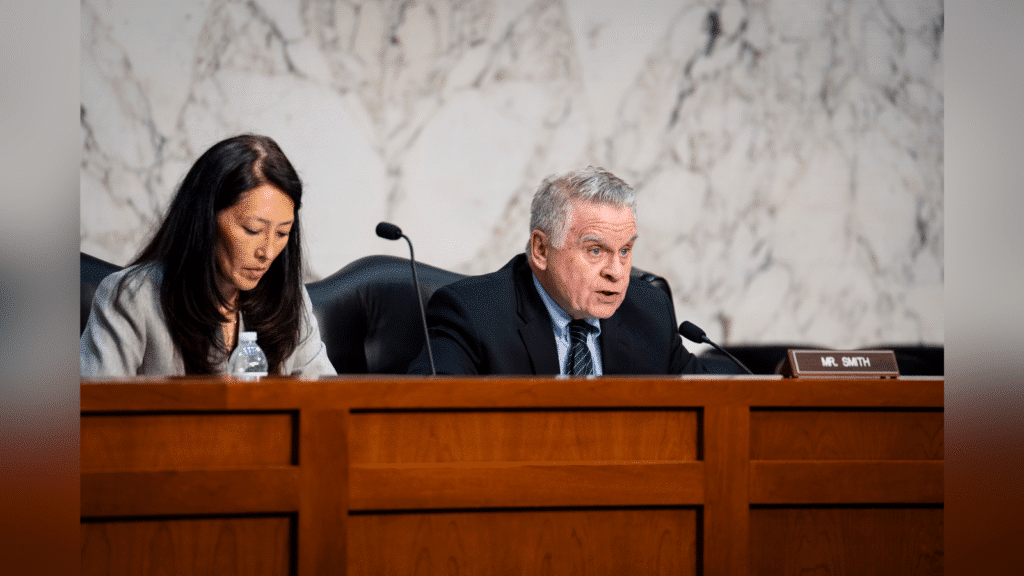
In his opening statement, Smith noted that the Commission’s 2025 annual report identified 485 Falun Gong practitioners among its cases of active detention. He added that practitioners living in the United States report surveillance, harassment, threats, physical assaults, property damage, and reprisals against relatives in China. “Once again, the repression does not necessarily end at the prison gate,” he said.
‘A top priority for the party’
Testifying on behalf of the American Falun Gong community, Zhang made three points. First, eradicating Falun Gong remains a top priority for the CCP. Second, the persecution has followed practitioners to the United States in various forms of transnational repression. Third, its impact reaches far beyond the Falun Gong community.
Zhang cited a 2024 U.S. Department of Justice statement noting that the Chinese regime views Falun Gong as one of the “top five threats” to its rule. Official speeches, local government documents, recent nationwide social media propaganda campaigns, and cash rewards offered to Chinese citizens who inform on practitioners all confirm this, he said.
Arrests, imprisonment, and deaths in custody continue. The Minghui website, which collects firsthand reports from inside China, has documented more than 5,300 deaths from abuse since 1999. Last year alone, Chinese courts sentenced more than 550 people to prison for practicing Falun Gong, and police arrested or harassed nearly 5,000 more.
Americans’ loved ones are among the victims. Zhang told the story of Grace Chen, who came to the United States at age 15 to study music and now serves in the U.S. Army. In 2020, her parents were arrested and imprisoned for studying Falun Gong teachings at a friend’s home. Since their release, Grace has learned that her father was doused with cold water, deprived of sleep, scalded with hot water, and forced to drink urine.
“My father is and will always be my hero,” Grace wrote in a statement Zhang read to the Commission. “His devotion to his faith, his courage to stand up against tyranny, and his unwavering love and care as a father make me profoundly proud of him.” She has not seen her parents in six years.
Repression on U.S. soil
Zhang said that while U.S. practitioners are no strangers to violence and intimidation from CCP actors, the pressure has risen sharply in recent years. He pointed to reporting by The Diplomat that in 2022 Xi personally ordered China’s security apparatus to escalate its targeting of Falun Gong worldwide, specifically through disinformation and lawfare.
Earlier this year, the research firm Graphika uncovered a network of bot-amplified websites impersonating major news outlets, pushing pro-Beijing content and attacking Falun Gong and Shen Yun Performing Arts, the New York-based classical Chinese dance company founded by Falun Gong practitioners.
Since March 2024, more than 310 violent and death threats have been directed at practitioners, their families, and Shen Yun, Zhang said. At least 100 of those threats also targeted American institutions and U.S. officials who have supported the community, including members of Congress and Secretary of State Marco Rubio.
He also cited the Falun Dafa Information Center’s (FDIC) June report, Americans Targeted by Beijing, based on a survey of more than 1,000 practitioners in the United States. Nearly half of respondents reported encountering transnational repression since 2022, and more than 600 cases were documented across 30 states, including physical violence, harassment, threats, surveillance, and reprisals against family members in China.
‘An emerging playbook’
Zhang’s third point was that the impact of the repression reaches far beyond the Falun Gong community. By the Chinese government’s own account, 70 to 100 million people practiced Falun Gong in China in 1999. In the years that followed, practitioners were detained by the millions, tortured, sexually abused, forced to produce goods that reached American shelves, and subjected to forced organ harvesting. That apparatus, Zhang said, was later turned on the Uyghurs.
The campaign has also undermined American institutions. Zhang pointed to the case of John Chen, who was sentenced in 2024 to 20 months in prison for acting as an unregistered agent of the People’s Republic of China (PRC). According to court documents, Chen and his co-defendant, Lin Feng, attempted to bribe an undercover agent posing as an IRS official to revoke Shen Yun’s nonprofit status. Court filings include a photograph of Chen shaking hands with Xi Jinping.
The two men also surveilled practitioners to collect information that would lay the groundwork for “potential environmental lawsuits meant to inhibit the growth of the Falun Gong community in Orange County, New York,” where Shen Yun is headquartered.
“This is a clear example of how CCP proxies sought to weaponize American laws and regulations as an instrument of foreign repression against Falun Gong,” Zhang said. “This does not stop with us. The full spectrum of tactics is an emerging playbook that can be pointed at any group the CCP decides is a problem.”
Chen is one of at least six agents of the Chinese government convicted in U.S. federal courts over the past five years for covert operations in which Falun Gong practitioners were among the principal targets, according to the FDIC’s incident tracker.
Calls to action
Zhang urged the Trump administration to raise Falun Gong during Xi’s visit, including the ongoing persecution in China and the transnational repression of practitioners in the United States, and to call for the release of those detained solely for their faith. “Such engagement would reinforce the U.S. commitment to human rights, national security, and protection of its citizens,” he said.
He also called on Congress to advance pending legislation on forced organ harvesting and to build on the transnational repression measures already introduced. In particular, he urged that future efforts address foreign-directed litigation against Americans and ensure that victims have a clear path to remedy.
Responding to the testimony, Smith recalled that he held his first hearing on forced organ harvesting 30 years ago. “It has now grown to an industrial-size exploitation of Uyghurs and Falun Gong,” he said. His Stop Forced Organ Harvesting Act passed the House by a vote of 406 to 1 in May 2025. In the Senate, the bipartisan Falun Gong and Victims of Forced Organ Harvesting Protection Act (S.4009), which now has 12 bipartisan sponsors and co-sponsors, would require sanctions on foreign persons who knowingly engage in or facilitate forced organ harvesting in China.
Later in the hearing, Zhang offered more specific proposals: extending the Foreign Agents Registration Act (FARA) to entities involved in foreign-directed litigation, adopting a federal anti-SLAPP statute to counter frivolous lawsuits brought against Americans by foreign entities, and requiring significant foreign funders of litigation in U.S. courts to disclose their funding sources and ties to foreign governments, including CCP membership.
“It is appalling that the CCP is weaponizing our institutions, especially the legal system, against American citizens,” Zhang said. He noted that Alisa Zhou, a U.S. citizen from Maryland, was in the audience. Her mother, Wang Youmei, remains held in a detention center in Wuhan, one of several cases the FDIC has asked President Trump to raise by name.
A bipartisan appeal
Zhang thanked Smith for his sustained support, noting that he led the effort to pass the first congressional resolution on Falun Gong in 1999. Despite the CCP’s efforts to silence the community, Zhang said, practitioners have built the largest information freedom movement in modern Chinese history, from anti-censorship software used by millions to underground printing sites and uncensored Chinese-language broadcasts. “Much of that work is based here, and it helps every group the party victimizes,” he said.
That bipartisan support was on display at the hearing. Ranking Member Rep. Jim McGovern (D-Mass.) said he had written to the president, together with other lawmakers, with a list of prisoners of conscience to raise directly with Xi. “Perhaps one of the deepest fears a prisoner of conscience can suffer is the fear that they have been forgotten,” he said. “That is why these events are so essential.”
Rep. Suhas Subramanyam (D-Va.) said the PRC has carried out a targeted campaign to detain and persecute religious and ethnic minorities, including the Falun Gong and Uyghur communities. “We have to call it out anytime we’re having any sort of bilateral conversation with China,” he said. “To not do so is irresponsible.”
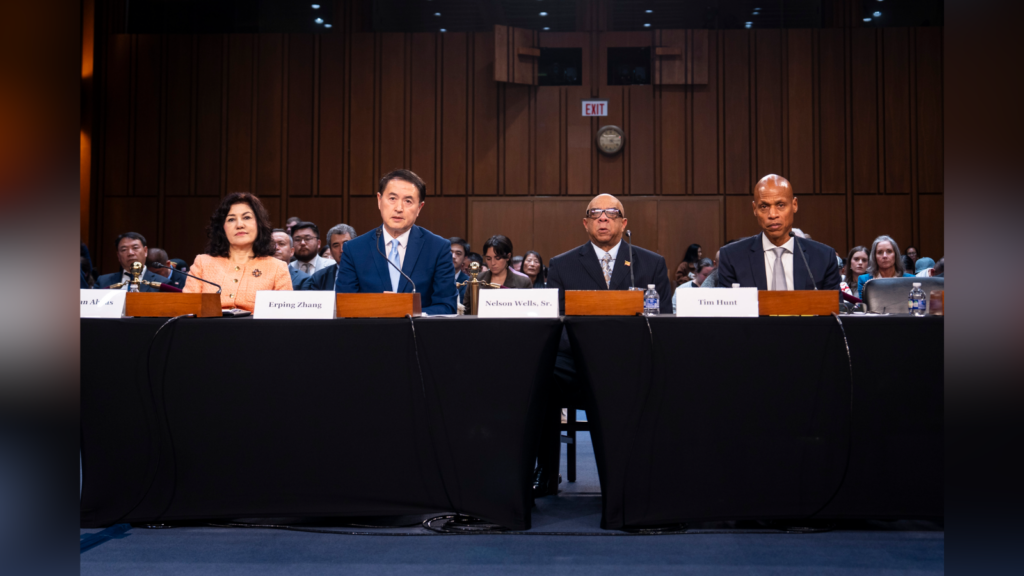
Other witnesses included Pastor Ezra Jin of Beijing Zion Church, who was released this summer after more than 260 days in Chinese custody; Rushan Abbas of the Campaign for Uyghurs, whose sister, Dr. Gulshan Abbas, remains imprisoned in Xinjiang; Nelson Wells Sr., father of Nelson Wells Jr., an American imprisoned in China since 2014; and Tim Hunt, brother of Dawn Michelle Hunt, who has also been imprisoned since 2014.
Closing the hearing, Smith said the Commission would immediately contact Secretary Rubio to ask that the witnesses’ cases be front and center at the summit. “This summit is a golden opportunity for the President to speak out and to do so boldly,” he said, urging him “to really own this issue of Americans detained as well as these other very important issues of the Falun Gong, the Christians.”
Read Erping Zhang’s full written testimony here.