
Beijing’s Diplomats in Ireland Tried to Censor Falun Gong’s Participation in a Local Parade
An accredited embassy asked an Irish city to exclude a religious minority from a public parade. It is the third such intervention documented in 2026, after France and Canada—and the clearest evidence yet that in the campaign against Falun Gong, the principal actor is not a proxy network but the Chinese state's own diplomatic service.
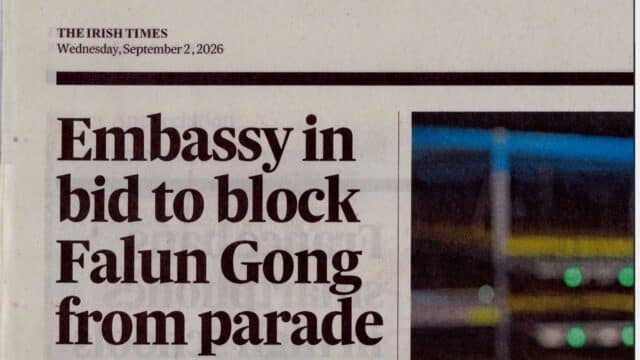
Corner of the paper publication of The Irish Times on September 2, 2026
Updated September 17, 2026 to reflect the City of Vancouver’s May 26 retraction
Most transnational repression (TNR) is designed not to be found. It moves through unregistered police stations, hired intermediaries, anonymous accounts, and community organizations that can be disavowed. The analytical literature has largely followed that design, concentrating on covert and deniable vectors.
The correspondence published by The Irish Times on September 2, 2026, describes something else. It documents an accredited diplomatic mission of the People’s Republic of China (PRC), writing on the record, from the office of the ambassador, to an Irish public authority, asking it to exclude a group of people from a civic event because of what they believe.
There is no proxy here to obscure attribution. The state signed its own name.
What the Galway file shows
The facts, as released under Ireland’s Freedom of Information Act and reported by Dara Bradley, are narrow and unusually clean.
On March 13, 2026, four days before Galway’s St Patrick’s Day parade, the personal assistant to China’s ambassador to Ireland emailed Galway City Council. The embassy, based on Ailesbury Road in Dublin, expressed “serious concerns” about the participation of Falun Gong practitioners in the March 17 event, and lobbied for their exclusion.
Three features of that email deserve the attention of anyone building a typology of state interference.
First, the demand was laundered through a local community. The embassy did not present the objection as Beijing’s. It said it had been approached by the Chinese community in Galway, who felt profound unease at Falun Gong’s inclusion. This converts a state instruction into what appears to be a minority community’s grievance, and puts the receiving official in the position of seeming to override local residents rather than declining a foreign government.
Second, Chinese domestic law was asserted extraterritorially. The embassy told the council that the Chinese government has proscribed Falun Gong as a cult on grounds of harm to social order and public health, that the ban followed the group’s criminal activities, and that outlawing it accords with the will of the Chinese people. None of this has any legal force in County Galway. It was offered as though it did.
Third, the appeal was made in the host country’s own idiom. The embassy argued that a celebration intended to honor Irish culture and community unity was an inappropriate venue for the group, and that the presence of such a cult directly undermines the parade’s Irish traditions. A foreign state told an Irish city what Irishness requires.
The council’s response is the part worth putting in front of legislators, because it is a model of what resistance looks like when it is procedurally grounded rather than rhetorical.
Officials consulted An Garda Síochána, Ireland’s national police service, in Galway, who raised no security concerns. An internal note recorded that Amnesty International has identified Falun Gong among groups harassed and imprisoned in China over religious practice, and attached supporting material. Derek Pender, the council’s director of services, then wrote back: the group had completed the required application and been approved under the parade’s established guidelines and procedures, and its participation would proceed on that basis.
No condemnation, no diplomatic note, no escalation. A public body simply applied its own published rules to an applicant and said so in writing.
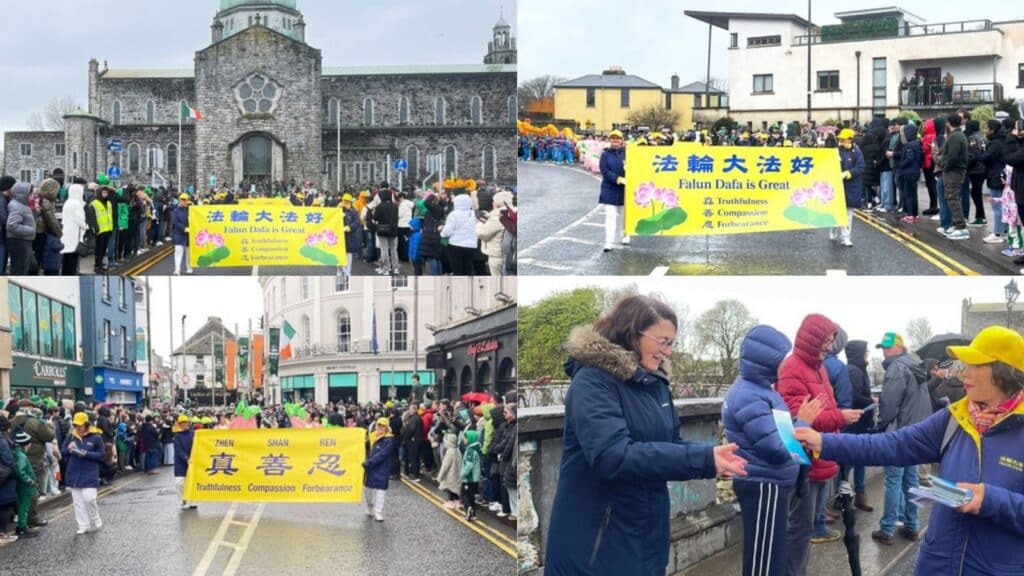
The practitioners marched on March 17. The Irish Falun Dafa Association, which has taken part in Irish parades for 15 years, said it was unsurprised. The Chinese Embassy did not respond to press queries.
One further fact should be recorded: this became public almost six months after the event, and only because a journalist filed for it. Nothing in the incident’s own machinery would ever have surfaced it.
Two more in the same season
Galway is not an outlier within 2026. It is the third documented instance this year of a Chinese diplomatic mission intervening with a local institution over a Falun Gong–related event—and in each case, the intervener was the mission itself, not an intermediary.
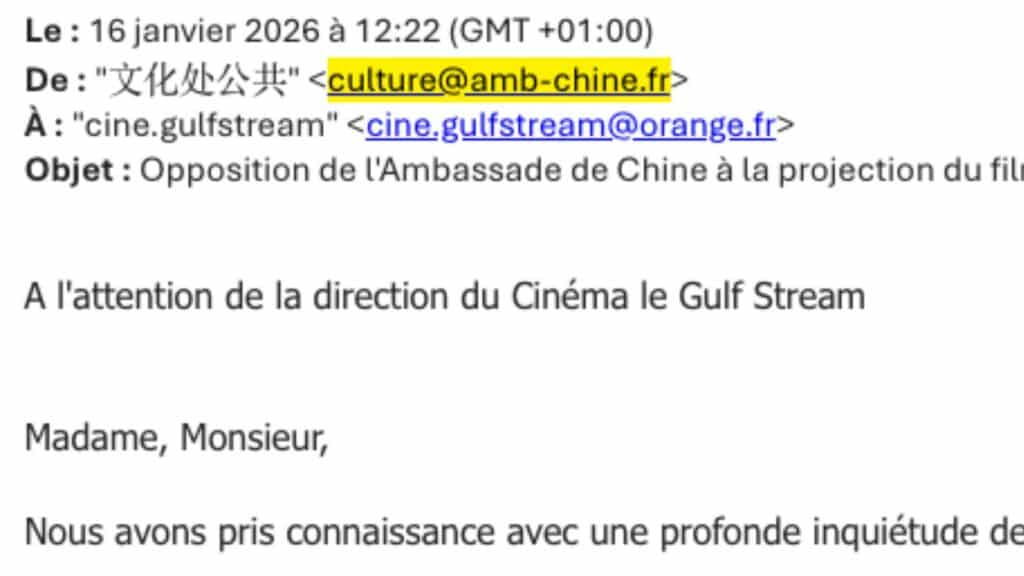
La Baule-Escoublac, France, January 16. At 12:22 that afternoon, the cultural service of the Chinese Embassy in Paris sent an email to the Gulf Stream cinema on France’s Atlantic coast. The subject line announced the embassy’s opposition to a screening of State Organs, a documentary on forced organ harvesting in China, scheduled for 8:30 that evening. Roughly eight hours’ notice.
A copy of the email, addressed to the cinema’s management, was provided to the Falun Dafa Information Center by Coeur de Jade Blanc, the association that organized the screening. The Center has reviewed the message in full; it is described here rather than reproduced.
Read against the Galway email, the architecture is the same and the demand is larger.
It opened by delegitimizing the work: the film was a disinformation operation built on fabricated accusations, designed to mislead the French public and serve a concealed political agenda. It then attacked the organizer, Coeur de Jade Blanc association, as directly linked to Falun Gong, which it characterized as a sectarian organization documented for extreme mental manipulation. It invoked Chinese domestic law exactly as Dublin later would: the government banned the organization in 1999 to protect its population and social order.
Then came the ask. The embassy urged the cinema not merely to cancel the screening immediately, but to renounce all present and future cooperation with the organizer—and warned the cinema against letting its institution become associated, even indirectly, with such a group.
That is a demand for a standing boycott, addressed to an independent cinema, in writing, from a diplomatic mission’s cultural department. It goes beyond anything in the Galway file.
By that afternoon the embassy had escalated twice more—telephoning the cinema directly, then contacting the town hall. Mayor Franck Louvrier declined to cancel.
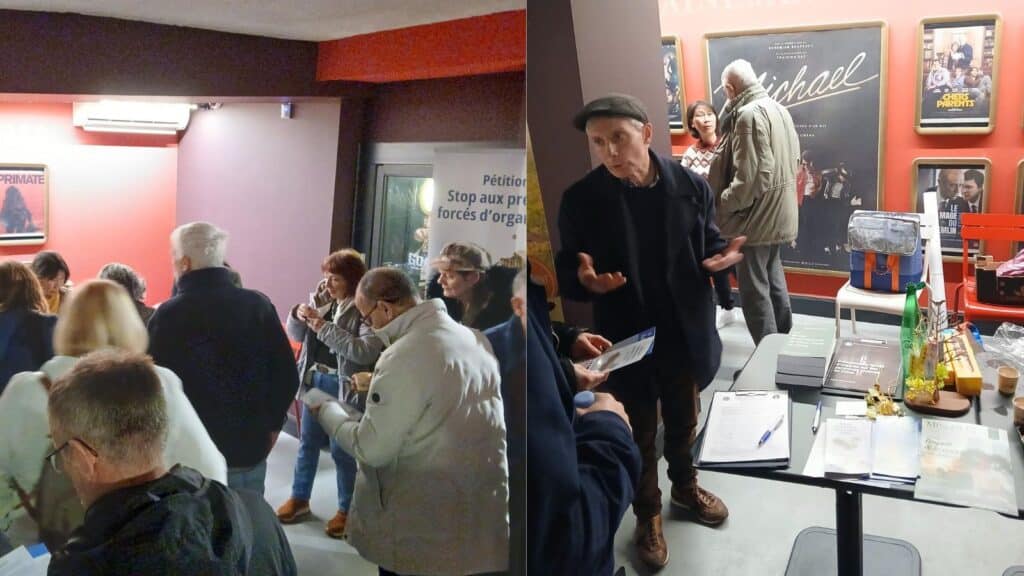
Three armed officers in body armour stood in the lobby while 68 people watched the film. It was presented by Bruno Merlin of Coeur de Jade Blanc association and by Dr Harold King, deputy director of Doctors Against Forced Organ Harvesting (DAFOH), a physicians’ organization nominated for the Nobel Peace Prize in 2016. Be Hai, a survivor of a Chinese labour camp, testified afterwards. Afterwards the audience signed the G7+7 petition, a campaign run by DAFOH and the International Coalition to End Transplant Abuse in China calling on the G7 governments and seven other states to act against forced organ harvesting in China, which had drawn more than 600,000 signatures worldwide by mid-2026. The same documentary had drawn the same treatment at Brétignolles-sur-Mer in the Vendée seven months earlier.
The relevant French authority has already classified this behaviour.
The Direction Générale de la Sécurité Intérieure (DGSI, it is the French special intelligence service under the authority of the Ministry of Interior) defines transnational repression as state action abroad to identify, locate, monitor, intimidate, censor, repatriate or kill political opponents, treats it as foreign interference, and lists it as a priority for the service. The La Baule incident looks adjacent to that definition. It may sit inside it.
Vancouver, Canada, early April. As Shen Yun Performing Arts prepared for an April 8–12 run at the city-owned Queen Elizabeth Theatre, Chinese consular officials requested and obtained a meeting with a staff member of Vancouver Civic Theatres. Global News reported on May 4 that sources said the consulate wanted the performances stopped, and that the employee was left shaken by the encounter.
On May 5, the office of Mayor Ken Sim issued a statement responding to the report. It said the meeting was not a breach of protocol and that no pressure had been applied by consular officials to cancel the event. The statement also said that staff had discussed the meeting with Global Affairs Canada—the federal department responsible for Canada’s foreign relations, including its dealings with foreign embassies and consulates—and confirmed that it fell within the bounds of a normal diplomatic interaction with China.
On May 26, the City of Vancouver corrected the second of those claims. In an email to Global News, city spokesperson Cecilia Ho said that Global Affairs Canada had not taken an official position on the meeting. The city attributed the earlier statement to an internal misunderstanding. Global Affairs Canada did not respond to questions from Global News about the incident.
The correction removes the federal assessment on which the city’s initial response relied. What remains documented is that a foreign consulate requested a private meeting with a municipal employee concerning a specific licensed cultural event, that the meeting took place, and that no Canadian authority has stated a position on whether it was appropriate.
Kennedy Stewart, who served as mayor of Vancouver from 2018 to 2022 and is now an associate professor at Simon Fraser University’s School of Public Policy, told Global News that the significant feature of the meeting was whom it involved. Consular officials had approached civil servants rather than elected representatives—”bypassing politicians, bypassing political avenues.” He said municipal staff have no means of responding to such approaches on their own, and that providing one is a responsibility of elected officials. Stewart recommended that the city instruct staff not to attend further meetings with consular officials and write to Global Affairs Canada requesting an investigation. He added that, in light of what he described as repeated conduct, the federal government could consider whether the consulate should remain open.
Several Canadian frameworks bear on conduct of this kind. Public Safety Canada defines foreign interference to include efforts to influence decision-making at any level of government through clandestine, deceptive or threatening means. The Canadian Security Intelligence Service (CSIS), Canada’s civilian intelligence agency, defines transnational repression as any effort undertaken by a foreign state, directly or indirectly, to intimidate, influence or exact reprisal against individuals or groups living outside its borders. Its list of tactics includes community ostracism: rejection from community associations, labelling people as extremists or traitors, and loss of access to social events.
In its 2025 public report, released on May 1, CSIS again named the PRC among the principal perpetrators of foreign interference against Canada. A submission to the Hogue commission by the Falun Dafa Association of Canada documented both the exclusion of Falun Gong groups from community events and interference with Canadian businesses that sponsored Shen Yun performances.
There is also a convergence in Vancouver that analysts should not pass over. In the same week as the consular meeting, on April 2, the theatre received an emailed bomb threat demanding the cancellation of all future Shen Yun performances. Police assessed it as a hoax. Vancouver police cybercrime officers traced the sending account to a phone number registered in China. No public evidence links that email to any Chinese mission, and it should not be asserted. But the two channels arrived at one venue, in one week, with one demand.
Campaign of Chinese communist regime
Three interventions, three countries, one season—and in each, the actor was an accredited mission of the People’s Republic of China.
Set alongside them the public track. Since January 1, 2026, the Falun Dafa Information Center (FDIC) has recorded at least six official statements from Chinese diplomatic missions defaming Falun Gong and Shen Yun: the Consulate-General in Sydney on January 2, the embassy in the United Kingdom on January 5, the Consulate-General in Melbourne on January 6, the embassy in Denmark on January 8, the Consulate-General in Marseille on January 24, and the embassy in Mexico on March 13—the same day the Dublin embassy wrote to Galway. Four missions in seven days across three countries, using near-identical vocabulary, is not a set of independent local judgements. The Mexico statement urged the public to avoid the performances in order not to be misled. Earlier entries in the same series came from Latvia in December 2024, the Netherlands in January 2025, Argentina in November 2025, and repeatedly from the Consulate-General in New York through 2025.
The inference is direct. For the Falun Gong community, the leading vector of transnational repression is not a shadow network operating at arm’s length from the Chinese state. It is the Chinese communist state, acting through its own diplomatic and consular establishment, using official channels, on official letterhead, in the ordinary course of its representation abroad.
Conclusion
That has three consequences for the people reading this.
For analysts: the leading datasets are not built to capture this. Freedom House’s database—1,375 direct, physical incidents between 2014 and 2025, with the PRC the most prolific perpetrator—records assassinations, assaults, renditions, detentions and deportations. An embassy letter is none of those. The three interventions described here appear nowhere in the figures that establish Beijing’s primacy.
The definitions, however, already reach them. The FBI defines transnational repression as foreign governments reaching beyond their borders to intimidate, silence, coerce, harass or harm members of their diaspora and exile communities in the United States. CSIS lists community ostracism among its tactics — rejection from community associations, loss of access to social events. The DGSI counts censorship of critics abroad. Freedom House’s own China study cites leaked 2015 speeches by senior Chinese security officials that name the use of diplomatic channels and host-country laws as instruments of the “overseas struggle” against party enemies.
What is missing, then, is not a legal category but a collection practice. Freedom House says so itself. Testifying to the Tom Lantos Human Rights Commission in June 2025, its research director Yana Gorokhovskaia described the database as only the tip of the iceberg of global transnational repression, because it relies on publicly reported and confirmed physical cases. In earlier testimony to the Congressional-Executive Commission on China, she described it as a conservative estimate drawn from public, verified direct attacks, which excludes incidents that are harder to confirm—and named Falun Gong practitioners among the entire religious groups the PRC targets. Overt diplomatic action is the best-attributed and least-collected evidence in the Falun Gong caseload, and the only category in which the state’s own conduct is documentary.
For legal specialists: Article 41 of the Vienna Convention on Diplomatic Relations obliges diplomats to respect the laws of the receiving state and not to interfere in its internal affairs. Lobbying a municipal authority to exclude a lawful religious minority from a public parade, or a licensed venue to cancel a performance, is not consular protection or cultural liaison. Receiving states have not been treating it as an Article 41 question. They should begin.
For legislators: there is already a request on the table to test whether governments will treat this as interference. On May 26, ahead of Chinese Foreign Minister Wang Yi’s visit to Ottawa—the first in a decade, and one taking place while Prime Minister Mark Carney pursues a trade agreement with Beijing—the Falun Dafa Association of Canada wrote to Foreign Minister Anita Anand asking her to raise the attacks on Shen Yun directly. The letter asked Canada to demand that China halt consular pressure on Canadian officials and venues, cooperate with police investigations into the bomb threats, and to affirm that Canadians may attend cultural performances and practice their faith free from foreign intimidation. Raising it on the record, the association argued, would signal that Canada takes coercive suppression of lawful cultural and religious expression seriously.
Whether that letter is answered is a measurable test of political will, and one that legislators in other capitals can replicate.
Beyond it, the collection problem remains. The Galway file exists because one journalist filed a freedom-of-information request. Vancouver’s meeting became public because a source spoke to reporters. La Baule surfaced because organizers documented it themselves. Meanwhile, an FDIC nationwide survey of 1,080 American practitioners, published in June, found 84 people across 18 states reporting 92 instances of exclusion from parades, community events and conferences—the same outcome the Dublin embassy sought in Galway, arriving in the United States without any embassy having to write.
There is no reporting mechanism anywhere in this record. A municipality that receives a foreign mission’s request to exclude a religious group has no obligation to log it, report it, or disclose it, and typically no idea that it should. Until that changes, the count of these incidents will not reflect their frequency—only the diligence of the journalists who happen to ask.
Galway got it right by treating the request as an ordinary permit matter and putting the answer in writing. That should not depend on the instincts of a single director of services.
For more on transnational repression targeting Falun Gong practitioners, visit faluninfo.net/transnational-repression/.