
New U.S. Bill Targets CCP Religious Persecution; German Intelligence Names Falun Gong Among Beijing’s Overseas Targets
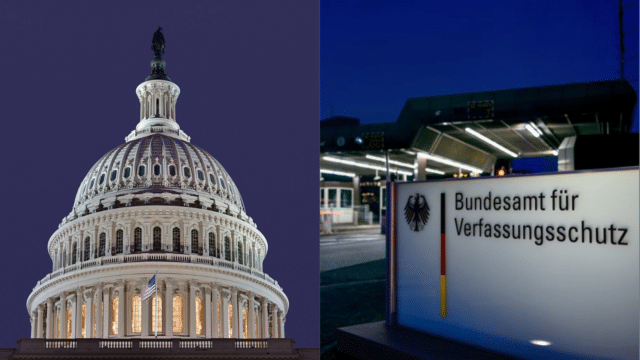
Left: The dome of the U.S. Capitol. (Public domain) Right: The entrance to Germany's Federal Office for the Protection of the Constitution (BfV) in Cologne. (BfV)
Two governments acted this month on the Chinese Communist Party’s (CCP) persecution of religious believers, and both named Falun Gong practitioners explicitly.
On Aug. 7, two U.S. senators—one Republican and one Democrat—introduced legislation that would treat Chinese officials responsible for religious freedom abuses as candidates for U.S. sanctions. On Aug. 20, Germany’s domestic intelligence service published a brochure on transnational repression that names China among the principal actors and Falun Gong practitioners among the groups Beijing pursues on German soil.
Sanctions sought in Washington
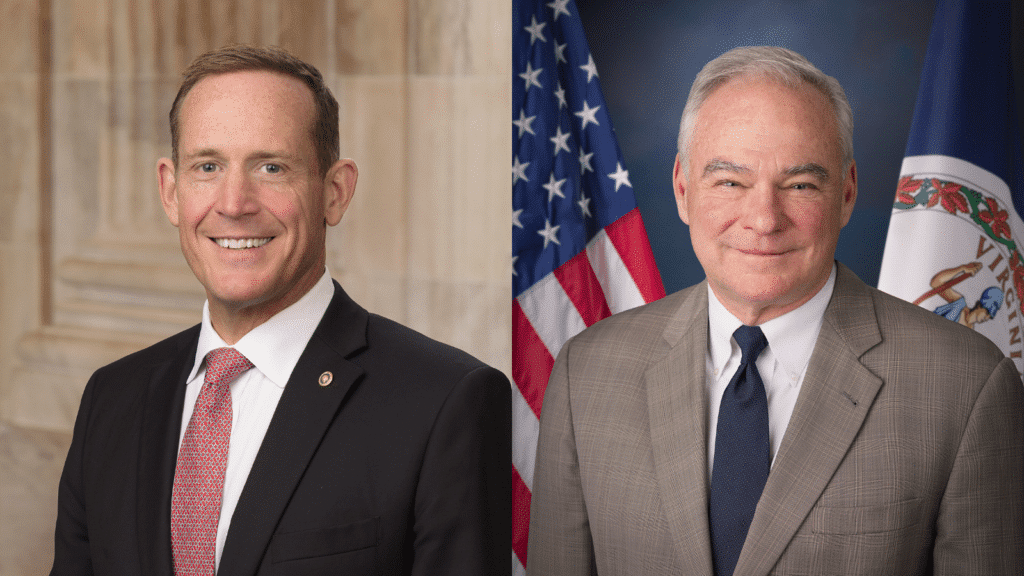
Sens. Ted Budd (R-N.C.) and Tim Kaine (D-Va.) introduced S. 5370, the Combatting the Persecution of Religious Groups in the People’s Republic of China Act, on Aug. 7. It would direct the U.S. government, whenever it finds a Chinese official responsible for abusing religious freedom, to also decide whether that official committed a gross human rights violation—the finding that triggers asset freezes and visa bans under the existing Global Magnitsky Act.
The abuses listed include arbitrary detention, forced sterilization, torture, and forced labor, along with serious restrictions on freedom of religion or belief, expression, and movement involving ethnic and religious minority groups. The groups it names are Tibetan Buddhists, Christians, Uyghur Muslims, and Falun Gong practitioners. Notably, the provision reaches abuses committed “in the People’s Republic of China or globally.”
The bill also directs State Department programming to monitor the CCP’s transnational repression of these groups, and requires the ambassador at large for international religious freedom to report annually to the Senate Foreign Relations and House Foreign Affairs committees on sanctions imposed on Chinese officials for human rights violations.
A second bill in the Senate
A related measure has advanced much further. S. 4009, the Falun Gong and Victims of Forced Organ Harvesting Protection Act, was introduced in March 2026 by Sen. Ted Cruz (R-Texas), with Sen. Jeff Merkley (D-Ore.) as original cosponsor. It was reported to the full Senate on July 27 and placed on the Senate calendar, where it now awaits a floor vote.
The bill has drawn cosponsors from both parties: alongside Merkley, Sens. Adam Schiff (D-Calif.), Ron Wyden (D-Ore.), Todd Young (R-Ind.), Ron Johnson (R-Wis.), and Mike Rounds (R-S.D.). Four more senators signed on in August: Catherine Cortez Masto (D-Nev.), Roger Marshall (R-Kan.), David McCormick (R-Pa.), and Raphael Warnock (D-Ga.).
S. 4009 would require the president, within 180 days of enactment, to submit and thereafter maintain a list of foreign persons determined to have knowingly and directly engaged in or facilitated forced organ harvesting in China, and to impose property-blocking and visa sanctions on those listed. It would separately require the secretary of state to report to Congress on China’s organ transplant policies and practices, including as they apply to prisoners of conscience and to Falun Gong practitioners specifically.
Germany: persecution that follows people into exile
On Aug. 20, Germany’s Federal Office for the Protection of the Constitution (Bundesamt für Verfassungsschutz, BfV), the country’s domestic intelligence service, released a public brochure on transnational repression titled “Invisible Shackles — Persecution into Exile.”
The agency names China alongside Iran and Russia among the principal actors. On China, it says the political leadership uses its intelligence services, and the bodies those services commission or control, to monitor and intimidate critics worldwide by means ranging from surveillance and threats to targeted harassment and intimidation.
Those affected in Germany, the brochure says, include Chinese activists, German critics of the one-party state, and members of groups the CCP regards as hostile to its system: Uyghurs, Tibetans, followers of Falun Gong, and supporters of Hong Kong’s democracy movement and of Taiwan.
The brochure catalogs methods including coercion and duress, censorship, covert intelligence gathering, online defamation, cyberattacks, the intimidation of family members still in the country of origin, and the abuse of international law enforcement mechanisms such as politically motivated wanted-person notices. Many of these, it notes, remain just below the threshold of criminal prosecution or cannot be clearly attributed to a specific case.
It also defines proxies as persons, organizations, or services that act in the interest of a hostile foreign intelligence service or other state body without belonging to it. These can include private detective agencies, students, work colleagues of targeted groups, cultural associations from the country of origin, and organized crime structures. Foreign powers, the agency says, increasingly leave execution to proxies so that perpetrators have no official connection to the state directing them.
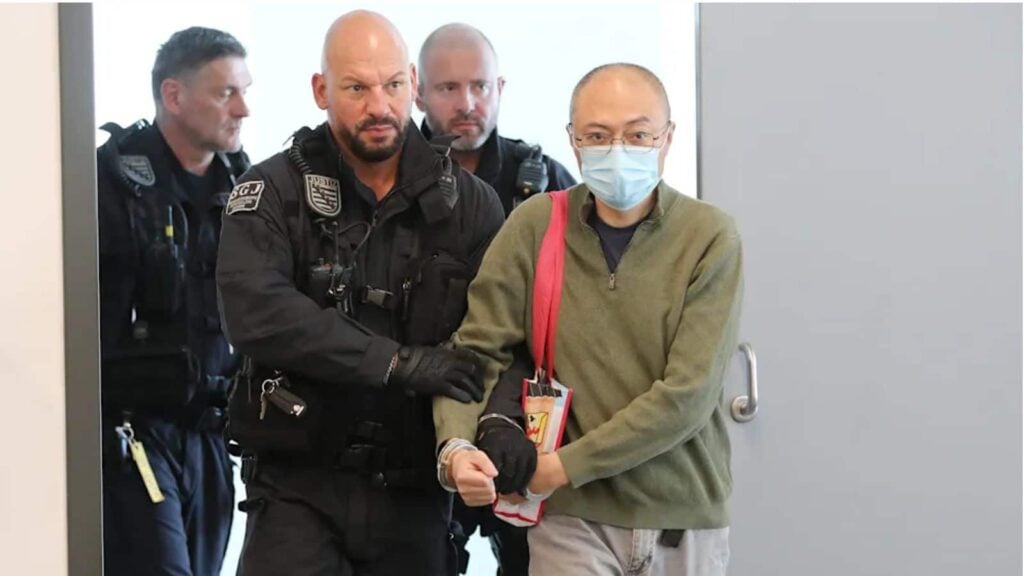
Photo: Dirk Sukow/Bild.de
German courts have already tried such a case involving Falun Gong. In September 2025, the Higher Regional Court of Dresden sentenced Guo Jian, a German citizen of Chinese origin and former parliamentary assistant to an Alternative for Germany (AfD) member of the European Parliament, to four years and nine months for particularly serious intelligence activity on behalf of China. The court found that Guo passed his Chinese handler information about the European Parliament’s January 2024 resolution condemning the CCP’s persecution of Falun Gong which specifically referenced the imprisonment of practitioner Ding Yuande in Shandong Province.
Same methods documented in America
The tactics the BfV catalogs closely match what the Falun Dafa Information Center (FDIC) has documented on American soil.
In a nationwide survey published in June, the FDIC collected 1,080 responses from Falun Gong practitioners in the United States and identified 646 credible encounters with transnational repression between 2020 and 2025. The tactics reported include physical assault, verbal harassment, property damage, violent threats, censorship, surveillance, and reprisals against relatives in China.
Incidents were documented in at least 30 states, and cases reported in 2025 rose more than tenfold over 2020. Chinese government entities were directly involved in 138 of the 646 cases.
U.S. courts and independent researchers have documented the same pattern. In November 2024, Ping Li, 59, of Wesley Chapel, Florida, was sentenced to four years in prison and fined $250,000 for conspiring to act as an agent of the Chinese government without notifying the attorney general. According to court filings, Li served for more than a decade as a “cooperative contact” for China’s Ministry of State Security, supplying information on Chinese dissidents, pro-democracy advocates, and Falun Gong practitioners in the United States — including, in 2012, the name and biographical details of a practitioner living in St. Petersburg, Florida.
In a January 2026 report, the social network analysis firm Graphika identified a network of 43 domains and 37 subdomains that pushed pro-Beijing messaging while impersonating major Western outlets, including The New York Times, The Guardian, and The Wall Street Journal. Graphika found that Falun Gong, Shen Yun Performing Arts, and Falun Gong’s founder were key targets of the network, and identified social media accounts — likely linked to the Spamouflage influence operation — that criticized Falun Gong and Shen Yun in identical posts published simultaneously while sharing links to the spoofed sites.
Where victims can turn
Germany’s BfV urges anyone who believes a foreign intelligence service is approaching, pressuring, or threatening them to contact its confidential tip-off line, which operates around the clock. Those facing an immediate threat are told to contact the police. In the United States, the FBI accepts tips at tips.fbi.gov and by telephone; victims are also encouraged to file a local police report, obtain an incident number, and preserve evidence.
The Falun Dafa Information Center continues to document these cases worldwide and asks anyone affected to report them to the appropriate authorities and to the FDIC at [email protected].
For more on transnational repression targeting Falun Gong practitioners, visit faluninfo.net/transnational-repression/.