
Argentine Falun Gong Adherents Assaulted at 2025 Chinese New Year Festival in Buenos Aires
Edit: This article was corrected from “eight hours” to “five hours” in the section about detention.
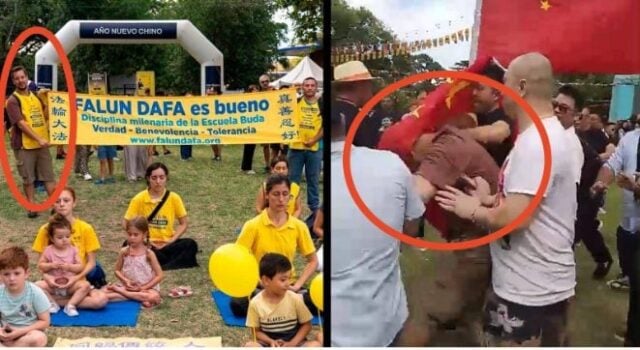
On January 26, 2025, during Chinese New Year celebrations in Buenos Aires, a coordinated assault targeted Falun Gong practitioners at Plaza Parque Nacionales Argentinos. Eyewitnesses and documented footage provided by the Falun Dafa Association of Argentina (FDAA) show a group of approximately 40 individuals, allegedly linked to the Chinese Embassy, attacking practitioners who were meditating or walking around the festival in yellow t-shirts. Local authorities from Buenos Aires City (CABA) reportedly instructed police not to intervene, leaving demonstrators vulnerable to violence. Several Argentine practitioners were detained for up to five hours without communication.
The incident has been reported by Latin American outlets including Agencia Nova, Realpolitik, La Posta de Mar del Plata, Fmartika, ML Diario, and Palabras y Verdades.
A coordinated assault
During the Chinese New Year festivities, Argentine citizens gathered for their regular advocacy and meditation at the event, expressing their beliefs by wearing yellow T-shirts or printed banners with the phrase “Truth, Benevolence, and Tolerance.” As the practitioners waited for the opening ceremony with their umbrellas and banners, an unidentified Chinese man in a white shirt and black cap walked through the crowd, speaking into his walkie-talkie and pointing to the practitioners. He directed an organized group of pro-Beijing individuals toward them, who immediately advanced and attacked.

Eyewitness footage from TikTok shows Ignacio Chirinos, a Cordoban Falun Gong practitioner who attended with his wife, being pinned to the ground by dozens of Chinese individuals, while his banner was seen being torn from his hands. The banner read, “The world needs Truth, Compassion and Tolerance.” An umbrella, which had a similar message, was also taken away.
Witnesses observed the attackers laughing dismissively when onlookers appealed for mercy, especially when women and children were attacked. In one case, a plainclothes woman who identified herself as being from the “[Argentina] Ministry of Security” tried to steal a yellow Falun Dafa t-shirt from a female practitioner and accused her of being a “terrorist.”
In another incident, Meilin Klemann was attacked by Chinese individuals while handing out informational Falun Dafa flyers and holding a yellow Dafa shirt.

Around eight men threw her to the ground to seize her belongings, and her phone and glasses were damaged as she tried to record the assault. Instead of arresting the attackers, the police put Klemann on the ground and arrested her. “When 10 people attack one person,” the officers claimed, “they must remove the one person.”
Despite the violence, local police, under alleged instructions from CABA, did not intervene or protect the Argentine citizens from unilateral assault. As a result, demonstrators suffered physical injuries, and their personal belongings and banners were forcibly seized.
One aggressor, after a brief detention near the Belgrano neighborhood, was released following confidential calls to monitoring officers. He left in a luxury car with his associates, while injured Falun Gong practitioners, including women and children, were detained and later faced charges of “resistance, aggression, and assault.”

Selective detention
Several demonstrators faced prolonged detention despite having committed no crime. For example, Romina García, holding her 5-year-old son, was detained for over five hours before being released. Klemann also reported experiencing severe pain during her detention, but refrained from speaking up for fear of further mistreatment.
In an interview with the Falun Dafa Information Center on January 29, 2025, Klemann shared her previous experience at the Chinese New Year festivities. In 2024, local Falun Dafa practitioners raised banners with the slogan “Falun Dafa is Good” at the inauguration ceremony. The live broadcast of the event to China reportedly caused significant embarrassment to the newly arrived Chinese ambassador in Buenos Aires.
Klemann believes, “So this year, they were more than prepared. The embassy organized dozens of Chinese thugs and local private security to ensure we would not be heard or seen. They literally waited for us, and the police were instructed to prevent us from displaying our message.”
In a particularly alarming incident in November 2018, Colonel Liu Chang, the military attaché of the Chinese Embassy, reportedly requested that Argentine police transfer nine Falun Gong practitioners to the Uruguay border during the G20 meeting in Buenos Aires for handover to Chinese agents. According to an Argentine government contact sympathetic to Falun Gong, federal officials refused to comply with this order. However, the detained practitioners were held for 18 hours without communication, an action resembling enforced disappearance. This incident was reported by Buenos Aires Times, Todo Noticias, and Minghui.
Systematic surveillance on site
During the event, a photographer from CABA’s police force, equipped with advanced technology, filmed Liwei Fu, the FDAA president for a prolonged period of time. Fu, who has faced threats and assaults by CCP-linked actors for over two decades, did not consent to the filming and requested the individual to stop. Although the photographer briefly paused, he resumed filming shortly after and ignored her privacy rights.
Local Argentine believers suggest that the Chinese Embassy has been compiling personal data, including facial recognition information, of citizens practicing Falun Dafa. Authorities appear to use information gathered from police photographers and other sources to identify and target practitioners. This raises serious questions about privacy, civil liberties, and transnational repression.
Historical context and implications
The events of January 26 take place against the backdrop of more than 25 years of documented persecution of Falun Dafa practitioners by the Chinese government. Over a decade ago, physical assaults on Falun Gong practitioners by local Chinese associations and Beijing-backed business groups during Xi Jinping’s visit made international headlines.

As the situation now stands, multiple criminal cases now await resolution in Argentine courts, including charges against peaceful demonstrators labeled as “resistance, aggression, and assault.” In contrast, none of the alleged aggressors with ties to the Chinese Embassy have faced significant legal consequences. Activists and human rights organizations warn that these actions reveal a disturbing alliance between local authorities and foreign agents intent on silencing dissent and repressing religious expression.
Prominent voices such as lawyer Alejandro Sarubbi Benitez and streaming host El Gordo Dan have publicly decried the repression. Both stressed that the observed suppression jeopardizes the fundamental freedoms of Argentine citizens and undermines democratic values.
A call for action: stopping transnational repression
The incidents in Buenos Aires underscore the urgent need for government accountability and international oversight. As evidence mounts of transnational repression against Falun Dafa practitioners, democratic governments, human rights organizations, and civil society must collaborate to ensure that law enforcement upholds human dignity and the rule of law.
The coordinated violence, selective detentions, and systematic surveillance of Falun Dafa practitioners in Buenos Aires reveal the dangers of foreign influence and local complicity. The international community must take action to hold responsible parties accountable and protect the fundamental freedoms of citizens. A transparent and thorough investigation is essential to safeguard democratic values and human rights.
The case also serves as a reminder that, while transnational repression may begin with individual cases, its implications affect the larger struggle for global human rights and freedom of expression. Governments and organizations worldwide must remain vigilant in supporting efforts to prevent such practices and defend the core principles of democracy.