
17 of Taiwan’s 22 Local Councils Pass Anti-Transnational Repression Motions After Bomb Threats Against Screenings of a Forced Organ Harvesting Documentary, With Some Naming the CCP
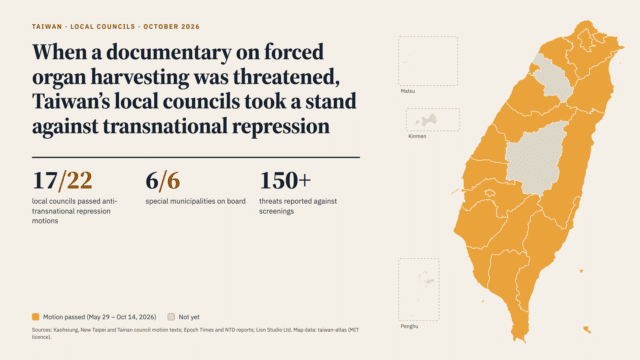
Between May 29 and October 14, 2026, 17 of Taiwan’s 22 city and county councils passed motions to combat transnational repression (反跨境鎮壓). The motions were a direct response to a campaign of bomb threats against screenings in Taiwan of State Organs, a documentary on forced organ harvesting in China. Their official wording attributes the threats to foreign forces (境外勢力), and some go further: the New Taipei and Kaohsiung texts name the Chinese Communist Party (CCP), as does Taoyuan’s, according to news reports.
Since October 2024, around 1,000 screening events of the forced organ harvesting documentary State Organs have taken place in Taiwan, drawing more than 150 threats according to the distributor’s public statement, quoted in Kaohsiung’s motion. Several councils were themselves targets: they had hosted screenings in their own chambers and received bomb and shooting threats. The draft motions also documented bomb threats against council buildings that had hosted screening events. The central government has since moved in the same direction. On October 1, 2026, the Mainland Affairs Council (MAC) provisionally classified a campaign against the film’s Taiwan distributor as transnational repression. On October 13, Premier Cho Jung-tai (卓榮泰) told the Legislative Yuan that the Anti-Infiltration Act would be amended to criminalize such acts.
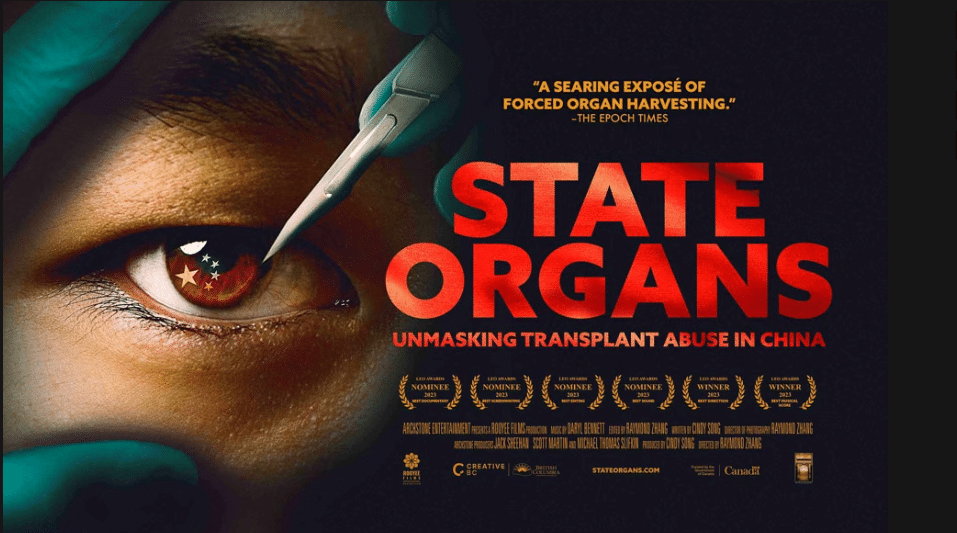
Screening events and death threats
State Organs is a Canadian documentary directed by Raymond Zhang (章勇進). It follows two families searching for missing relatives and alleges state-run forced organ harvesting in China, with Falun Gong practitioners among the main victims; Beijing rejects such allegations. Its Taiwan distributor, Lion Studio Ltd. (雄獅影視文化), led by Kuan Chien-chung (管建忠), held its theatrical preview in Taipei on July 15, 2024.
According to Lion Studio, the threats frightened cinemas into backing away from a regular theatrical release of the film. It has instead been shown almost entirely through private bookings (包場), which are not advertised on cinema websites and so put less pressure on the venue. Each booking is run as an event, typically with a post-screening discussion, audience Q&A, small souvenirs and a petition against forced organ harvesting. By October 2026 there had been close to 1,000 such events.
Many were hosted by elected officials, including in council buildings. That put councils directly in the line of fire:
- Kaohsiung City Council received an email on October 29, 2024 threatening to blow the council “into ruins” unless a November 2 screening it was hosting was cancelled. Mayor Chen Chi-mai (陳其邁) ordered police to investigate.
- Taipei City Council’s DPP (Democratic Progressive Party) caucus received a threat on November 23, 2024, left through the screening’s online sign-up form under a false name, vowing to enter the council and attack people with a knife during its November 30 screening. The caucus reported it to police, 51 officers were deployed, and the event went ahead.
- Tainan City Council’s own screening on December 9, 2024 was targeted by eight threats, as the council later recorded in its motion (below).
Examples of Motion document
Three council motions set out the threat campaign in their own words.
Kaohsiung’s motion cites Lion Studio’s public statement that the distributor and cinemas received more than 150 threats between the 2024 release and early 2026, including bomb threats and shooting warnings intended to force cinemas to stop screening. It adds that some messages were sent in the name of Taiwan’s head of state, and calls the campaign organized and systematic.
New Taipei’s motion cites Taiwan’s National Security Bureau: from October 2024 to November 22, 2024, New Taipei alone recorded three threat cases against screenings. It repeats Lion Studio’s figure of more than 150 threats nationwide and names the perpetrator directly, describing transnational repression as the CCP authorities or their agents using intimidation, threats, surveillance, harassment or violence, including threats against State Organs screenings (New Taipei City Council motion; see below).
Tainan’s motion attaches a summary of threats against screenings in the city (Attachment 1, see the original PDF version and translated table below). It records 30 threatening messages, which investigators traced to IP addresses outside Taiwan: 23 between late October and December 2024, six in January 2025, and one on April 7, 2026 at National Cheng Kung University. They were spread through LINE (8), YouTube (5), electronic billboards (5), flyers (4), Facebook (4), Instagram (3) and an NCKU suggestion box (1).
Attachment 1, translated and condensed:
| Date (sent) | Venue targeted | Threat |
| Oct 31, 2024 | Labor recreation center | Claims explosives were planted at the venue’s address; demands the screening be cancelled and announced online by 6 p.m. |
| Nov 10, 2024 | Labor recreation center | Threatens to shoot security staff and throw petrol bombs into the audience |
| Dec 1, 2024 | Tainan City Council | Threatens to bring armed men in once the screening starts and shoot everyone |
| Dec 2, 2024 | Tainan City Council | Claims RDX bombs were placed around the council; demands all screenings be cancelled, cooperation with Lion Studio ended and a public statement posted on Facebook by 6 p.m. |
| Jan 19, 2025 | Labor recreation center | Threatens to assassinate Falun Gong members and US politicians who support them |
| Jan 25, 2025 | Madou Theater | Threatens to burn down the theater if the film is shown |
A new tactic: impersonating the distributor
On October 1, 2026, MAC deputy minister and spokesperson Liang Wen-chieh (梁文傑) announced a new pattern.
Besides bomb threats against Kuan, someone has been using his name and phone number to threaten others: a lawyer in November 2025, the Kuma Academy in December 2025 and the Falun Dafa Association on September 29, 2026. Each time, Kuan had to answer to police or prosecutors. Liang said the purpose was to wear him out, and that the operation was systematic rather than simple impersonation, so the MAC provisionally listed it as a transnational repression case and asked the National Police Agency and Ministry of Justice to handle the reports together. On October 5, Liang and the Straits Exchange Foundation met Kuan to express the government’s support.
What the motion texts say
The motions do not treat State Organs as background. They make the threats against its screenings the case on which the whole request rests. The three texts available so far, from Kaohsiung, New Taipei and Tainan, show this most clearly.
Kaohsiung City Council: the first motion (May 29, 2026)
Proposal No. 103 of the council’s 4th term, 7th regular session, was filed by councilor Chen Li-na (陳麗娜) with co-signers Hsu Tsai-chen (許采蓁), Liu Te-lin (劉德林) and Wang Yao-yu (王耀裕). Its subject line (案由) reads:
為維護我國民主法治與文化表達自由,建請市府針對「雄獅影視文化有限公司」引進紀錄片《國有器官》遭跨境恐嚇事件採取積極保護措施,支持擴大電影放映行動,並建請中央政府推動「反跨境鎮壓」專法,以保障國人免受境外勢力之威脅與騷擾。
(Translated) To uphold our country’s democracy, rule of law and freedom of cultural expression, the city government is requested to take active protective measures in response to the cross-border intimidation of the documentary State Organs (brought to Taiwan by Lion Studio Ltd.), to support wider screenings of the film, and to ask the central government to enact a dedicated anti-transnational repression law to protect citizens from threats and harassment by foreign forces.
The motion defines transnational repression as intimidation, threats, surveillance, harassment or violence carried out abroad by a foreign government or its agents against dissidents or particular groups. As models, it cites the US Transnational Repression Policy Act, Germany and Texas bill SB1349. It then sets out five measures:
- Security. Police to step up patrols and safety checks at cinemas and arts venues showing human-rights films such as State Organs.
- Support for screenings. The culture and education bureaus to support and promote documentaries that expose human-rights abuses.
- Central legislation. The central government to speed up an anti-transnational repression law, drawing on US and German experience. Within one month the city must write formally to legislators stating Kaohsiung’s support and urging them to table a bill.
- Public awareness. Police and the information bureau to design courses on common tactics and reporting channels, for community colleges and high school civics classes.
- Follow-up. The police, culture and education bureaus to report progress to the council in writing within three months.
Source: Kaohsiung City Council proposal database.
New Taipei City Council: naming the CCP (Oct 1, 2026)
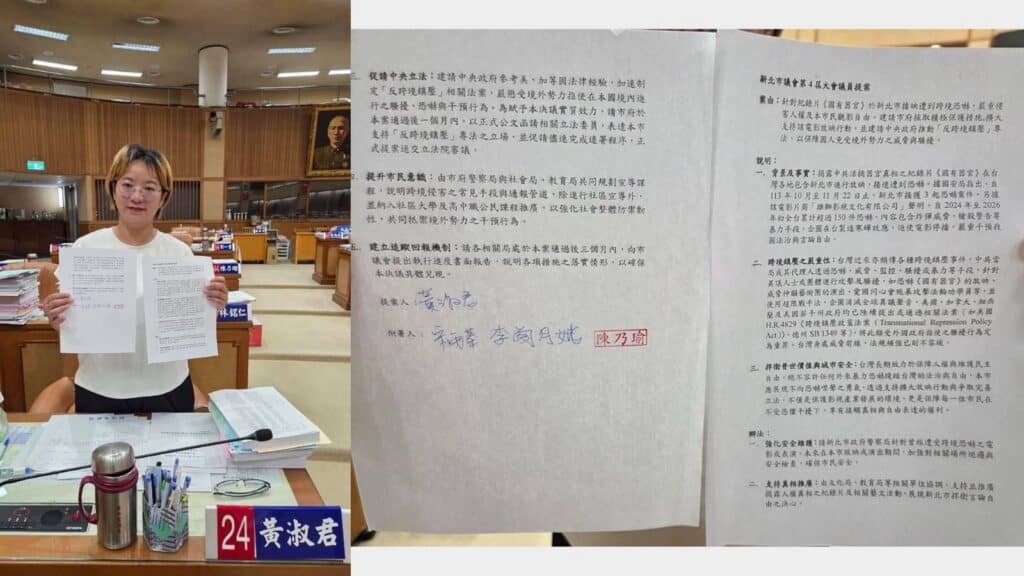
New Taipei’s motion, a councilor proposal to the council’s 4th term, follows Kaohsiung’s structure closely but adds local evidence and is more explicit about who is responsible. It was proposed by councilor Huang Shu-chun (黃淑君) and co-signed by Li Shang Yueh-o (李尚月娥), Chen Nai-yu (陳乃瑜) and others. Its subject line reads:
針對紀錄片《國有器官》於新北市播映遭到跨境恐嚇,嚴重侵害人權及本市民觀影自由。建請市府採取積極保護措施,擴大支持該電影放映行動,並建請中央政府推動「反跨境鎮壓」專法,以保障國人免受境外勢力之威脅與騷擾。
(Translated) The documentary State Organs has met cross-border intimidation during its screenings in New Taipei, seriously infringing human rights and residents’ freedom to watch films. The city government is requested to take active protective measures and expand support for screenings of the film, and the central government is asked to push for a dedicated anti-transnational repression law to protect citizens from threats and harassment by foreign forces.
The explanation makes three points:
- Local evidence. Citing the National Security Bureau, it records three threat cases in New Taipei between October 2024 (ROC year 113) and November 22, 2024. It adds Lion Studio’s count of more than 150 threats nationwide from 2024 to early 2026, including bomb threats and shooting warnings meant to create a chilling effect and stop the screenings.
- Attribution. It describes transnational repression as the CCP authorities or their agents using intimidation, threats, surveillance, harassment or violence against dissidents and groups, and gives three examples: the threats against State Organs screenings, threats against Shen Yun performances, and an attack on Falun Gong practitioners by members of the Concentric Patriotism Association (愛國同心會).
- Models. It notes that the US, Canada, New Zealand and several US states have proposed or passed laws, citing US bill H.R.4829, the Transnational Repression Policy Act, and Texas SB 1349.
Its five measures match Kaohsiung’s: police patrols and safety checks at venues for films and performances that have been threatened; support from the culture and education bureaus for human-rights documentaries; a formal letter to legislators within one month backing a dedicated law; awareness courses run by the police, social affairs and education bureaus, including in community colleges and high school civics; and a written progress report to the council within three months.
Tainan City Council: the most detailed motion (Oct 6, 2026)
Tainan’s motion (4th term, 8th regular session, security category, No. 1) was proposed by 15 councilors led by Tsai Hsiao-wei (蔡筱薇) and co-signed by 16 more, including Speaker Chiu Li-li (邱莉莉). It was reviewed in committee on October 1, 2026, with the opinion that it be forwarded to the city government for action, and adopted by the plenary on October 6. Its subject line reads:
為維護我國民主法治與國民基本人權,完善合法文化展演的安全協處及反跨境恐嚇的防護機制,建請臺南市政府以國際人權紀錄片《國有器官》於臺南放映期間遭受跨境恐嚇事件為具體案例,建立常態協處維護機制,並加強教育與宣導機制強化市民的相關認知。同時,促請行政院、立法院及相關中央機關,盡速完善反跨境鎮壓相關法制,保障合法舉辦之活動及國民基本人權。
(Translated) To uphold democracy, the rule of law and citizens’ basic human rights, and to build safety support for lawful cultural events and protection against cross-border intimidation, the Tainan City Government is requested to use the cross-border intimidation of the international human-rights documentary State Organs during its Tainan screenings as a concrete case for establishing a standing support mechanism, and to strengthen education and outreach. The Executive Yuan, Legislative Yuan and relevant central agencies are urged to complete the legal framework against transnational repression as soon as possible.
The explanation calls State Organs a vivid example of Taiwan’s democracy and human rights coming under violent threat from abroad. It notes that the Executive Yuan has recently set up a cross-agency coordination mechanism on transnational repression, and argues that Tainan needs a local counterpart so that organizers and venues can quickly reach a contact point when threatened. Its measures go further than Kaohsiung’s:
- Publicly oppose intimidation of lawful events.
- Use State Organs in public education on transnational repression and forced organ harvesting, through the police, civil affairs, health and culture bureaus, and in-service teacher training.
- Make city-run venues and community centers available for human-rights documentary screenings.
- Designate a lead agency and contact point, with a procedure and joint risk assessment for threatened events.
- Train venue staff in event security, folded into existing safety and fire drills.
- Have the council write to Tainan’s legislators and to relevant Legislative Yuan committee members.
- Require a preliminary written report within three months and a results report within six, with the case kept on the council’s follow-up list.
Source: Tainan City Council motion record, with Attachment 1 (threat summary) and Attachment 2 (three Kaohsiung proposals, all adopted).
Keelung and Taoyuan: the latest motions
Keelung City Council became the 17th on October 14, 2026, passing two temporary motions tabled by the DPP caucus: one against transnational repression and one to screen State Organs at the council and district offices. Independent councilor Chen Kuan-yu (陳冠羽) supported them, noting that local governments cannot legislate on what is ultimately a national matter but can inform residents. Taoyuan’s motion of October 13, filed by independent Yu Pei-chen (于北辰) and DPP councilor Wei Yun (魏筠) with 21 cross-party signers, cited bomb and stabbing threats against Taoyuan screenings in November 2024 and June 2025; its official text has not yet been published online.
The pattern
The texts share a structure. Each starts from threats against a specific film, generalizes them into a threat to free expression and national security, asks the local government for security, education and support for screenings, and ends with a call on the central government to legislate, usually with a deadline for the local executive to report back. Sponsors have come from the DPP, KMT (Kuomintang), independents and smaller parties, a breadth that councilors cite as evidence that the issue is not partisan.
Recommendations to US lawmakers
Taiwan’s experience shows that anonymous bomb and death threats have become the leading edge of transnational repression against films, performances and the people who host them. The same pattern is unfolding in the United States, and the US policy response lags behind the one now taking shape in Taiwan.
Washington already recognizes the stakes. The Justice Department’s National Security Division defines transnational repression as the range of tactics foreign governments use to reach beyond their borders to harm, intimidate, threaten, harass or coerce individuals, and lists religious minorities among the usual targets. It calls transnational repression a threat “to United States’ sovereignty and democracy,” and says holding perpetrators accountable is “a top priority.” The bomb and death threats against Falun Gong, Shen Yun and their hosts fit that definition squarely.
The same campaign on both sides of the Pacific
The Falun Dafa Information Center (FDIC) has documented 318 anonymous death and bomb threat incidents since March 2024, as of October 16, 2026. Of these, 220 targeted Falun Gong practitioners (164 related to Shen Yun Performing Arts), 211 targeted government officials or institutions worldwide, and 101 targeted US officials or institutions; the categories overlap. Targets have included theaters hosting Shen Yun, the Kennedy Center, members of Congress, the State Department and the White House.
The threats in Taiwan and the US share features that point to a common source:
- The same script. A January 19, 2025 threat against a Tainan screening of State Organs, recorded in Tainan’s council motion, vowed to assassinate Falun Gong members and supportive US politicians and then flee to countries with no US extradition treaty. Six days earlier, on January 13, a threat sent to a US anti-organ-harvesting website made the same claims: attacks on members of Congress who support Falun Gong, and multi-country visas for escaping the US.
- The same tactics. In both countries, senders impersonate real people to cause trouble for them, from the State Organs distributor in Taiwan to Falun Gong spokespeople and public officials in the US.
- Traces back to China. Taiwan’s Criminal Investigation Bureau reportedly traced bomb threats against Shen Yun performances in Taiwan to Xi’an, China, despite the use of VPNs, according to Liberty Times as cited by the FDIC. In New York, police said threats that forced the evacuation of a Flushing library in April 2025 were traced to IP addresses in China.
Yet despite the Justice Department’s stated priority, the FDIC reports no arrests so far. And unlike the direction Taiwan is now taking, US federal law does not yet treat transnational repression as a crime in its own right. A bipartisan Senate bill that would change this, the Stop TNR Act of 2026 (S. 4967), was introduced in July 2026 and is with the Senate Judiciary Committee.
What Congress can do
- Make transnational repression a federal crime. Taiwan’s councils pushed their government toward a law that names transnational repression as a crime, and the government has agreed to act. Congress could do the same by passing legislation like the bipartisan Stop TNR Act of 2026 (S. 4967), introduced by Senators Adam Schiff and John Curtis, which would define transnational repression in federal law for the first time and bring tougher penalties for crimes committed on behalf of a foreign government
- Treat serial threats as one case. Taiwan’s Mainland Affairs Council asked police and prosecutors to handle scattered reports as a single series. US agencies could take a similar approach, treating threats against performances, screenings and their hosts as one pattern rather than unrelated incidents, and reporting on them publicly so the scale of the campaign is visible.
- Protect the hosts. Taiwan’s councils ordered police patrols and venue checks for threatened events. Congress could help theaters, universities and community venues that host targeted events with security support and guidance, so that a bomb threat does not become a cheap way to cancel a show.
- Work with Taiwan. When identical threats reach Tainan and New York within a week, finding out who is behind them requires both sides to share what they know. Closer cooperation between US and Taiwanese law enforcement on these cases would help.
- Impose costs. Where threats are traced to Chinese state actors, the US can respond with sanctions. Congress could also move the Falun Gong Protection Act (H.R. 1540), which passed the House in May 2025 and has been waiting in the Senate Foreign Relations Committee since.
- Urge states to follow Texas. Taiwan’s response began bottom-up, with 17 local councils, and US states need not wait for Congress either. In 2025 Texas passed SB 1349, which brings tougher penalties for crimes such as harassment or stalking committed on behalf of a foreign government and requires training for state police. Members of Congress could encourage their own state legislatures to pass similar laws, especially in states with large Falun Gong communities and high numbers of transnational repression incidents, such as New York and California, so that state and local police treat these threats as transnational repression rather than isolated pranks.