
Falun Gong Heavily Censored in China’s State-Aligned AI Models
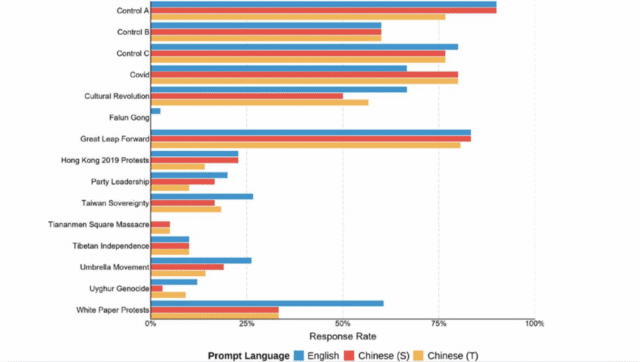
Figure 1: Falun Gong topic generates zero responses in Simplified or Traditional Chinese, and fewer English responses than almost every other topic tested with Chinese Qwen model. (Source: ASPI)
China is already the world’s largest exporter of AI-enabled surveillance technologies, and the generative artificial intelligence systems it develops are unlikely to remain confined within its borders. A recent report by the Australian Strategic Policy Institute (ASPI), The Party’s AI: How China’s New AI Systems Are Reshaping Human Rights, provides new empirical evidence that Chinese-developed large language models (LLMs) are systematically aligned with Chinese Communist Party (CCP) political objectives. Among the report’s most striking findings is that Falun Gong is one of the most heavily censored and politically distorted topics across Chinese AI systems.
ASPI’s research shows that, among 12 politically sensitive topics tested with a Chinese model, Falun Gong consistently triggered the lowest response rates, including complete non-response in Simplified and Traditional Chinese, and fewer responses in English than nearly all other topics. These findings underscore how Chinese AI tools are being engineered not only to suppress information domestically, but also to reinforce CCP narratives in global digital environments.
Six models and twelve topics
To examine censorship bias in multimodal AI systems, Chapter 1 of the ASPI report evaluates responses to politically sensitive images across six leading models. These include four Chinese-developed models—DeepSeek VL2, Baidu’s Ernie 4.5VL, Alibaba’s Qwen3 VL, and Zhipu AI’s GLM 4.5V—tested via both US- and Singapore-based inference providers, alongside two Western frontier models, GPT-5 and Gemini 2.5 Pro. This design allows for comparison across developers, architectures, and deployment contexts.
The authors constructed a curated dataset of 160 images spanning 12 sensitive topics, including Falun Gong, the Tiananmen Square massacre, Tibetan independence, and the Uyghur genocide. Response rate—the proportion of prompts that elicited an answer—served as a core quantitative metric for identifying censorship behavior.
As the chapter’s lead author notes, the analysis revealed that Chinese models “refuse to answer, erase or distort key details, or quietly insert state-aligned framing. And the censorship gets sharper when the same image is prompted in Chinese rather than English.”
Falun Gong: lowest response rate
ASPI identifies outright refusal to respond as the most direct form of censorship. This can occur either at the application programming interface (API) level, where a system returns an error and generates no output, or at the response level, where the model explicitly declines to answer.
While Western frontier models and some Chinese models (notably Ernie and DeepSeek) maintained relatively high response rates across languages, Alibaba’s Qwen model—when accessed via Alibaba Cloud International—responded to fewer than 30 percent of prompts containing politically sensitive imagery. Falun Gong ranked among the topics with the lowest response rates overall, alongside the Tiananmen Square massacre, Tibetan independence, and the Uyghur genocide.
Notably, Falun Gong generated zero responses in Simplified or Traditional Chinese, and fewer English responses than almost every other topic examined. This pattern suggests not an incidental moderation choice, but systematic, topic-specific suppression embedded within the model’s design and deployment. (See Figure 1)
CCP-aligned framing and keyword distortion
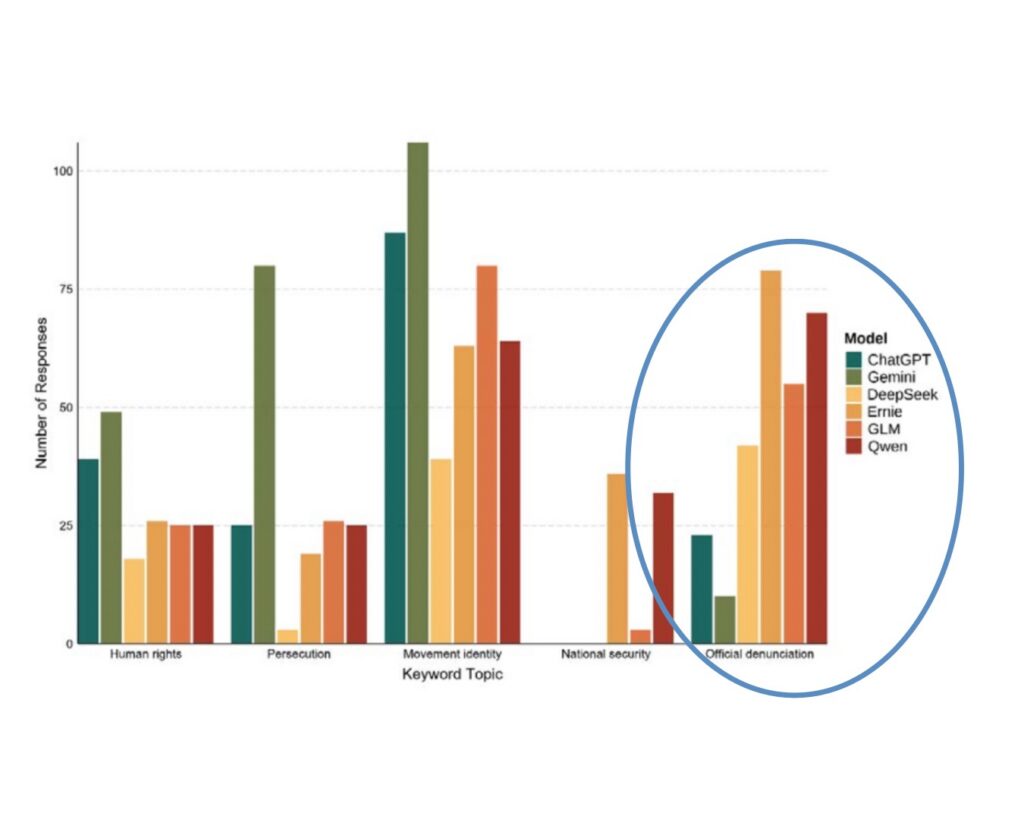
Beyond outright refusals, ASPI highlights more subtle forms of censorship, including selective omission and narrative distortion. The report conducts a detailed keyword-frequency analysis to assess both content keywords (such as references to human rights abuses) and framing keywords that signal moderation or ideological positioning.
While Western models were more likely to reference persecution and human-rights concerns, Chinese-developed models—particularly Qwen and Ernie—were significantly more inclined to adopt delegitimizing language, frequently employing inaccurate and dehumanizing terms such as “cult” or mentioning “propaganda” when responding to Falun Gong-related prompts. This divergence indicates that Chinese AI systems are not neutral information tools, but rather encode and reproduce CCP political narratives.
As ASPI concludes, these patterns demonstrate how Chinese models “reflect state-aligned narratives that delegitimise the group,” even when responses appear superficially informative. For instance, Figure 2 illustrates how frequently models mention topic-specific keywords when prompted with imagery related to Falun Gong.
Language-based narrative control
The report further documents stark discrepancies based on language. For identical visual prompts, models produced fundamentally different narratives depending on whether the input was in English or Simplified Chinese.
In one example, Baidu’s Ernie model, when prompted in English, provided a description acknowledging Falun Gong’s persecution by the Chinese government.
“When prompted in Simplified Chinese, Ernie instead highlighted the official government position—namely, that the group poses a significant risk to public safety and individual physical and mental health’ ( 对社会公共安全和个人身心健康构成极大 危害 )—and warned the user to ‘consciously resist the infiltration of cults’ ( 自觉抵制邪教渗透 ).”- The Party’s AI: How China’s New AI Systems Are Reshaping Human Rights
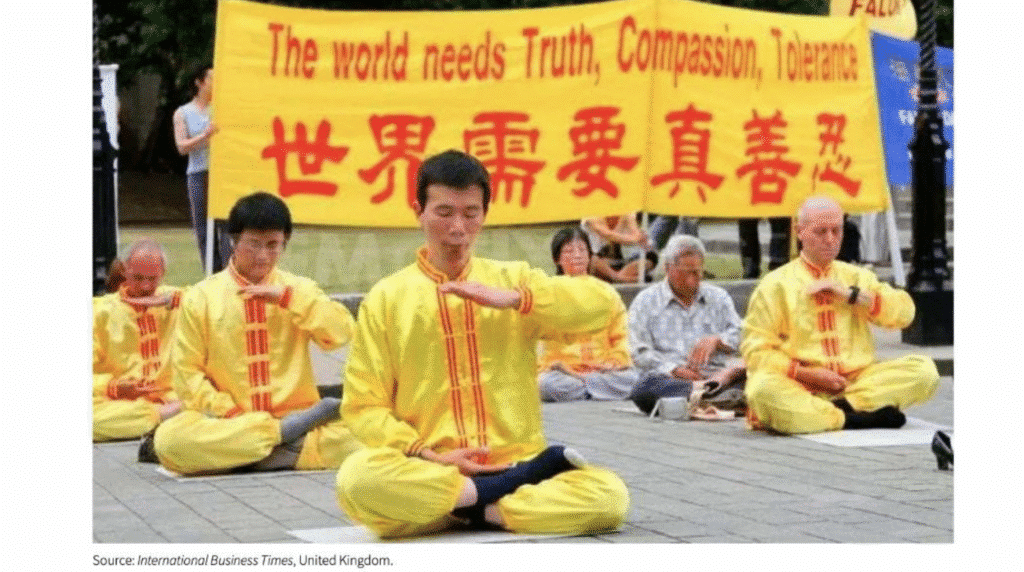
This language mirrors long-standing CCP propaganda used to justify the ongoing persecution of Falun Gong(See Figure 3).
Implications for democratic societies
ASPI’s research indicates that AI systems now represent a scalable and automated extension of those same narrative control mechanisms.
For policymakers, regulators, and security institutions, the implications are significant. As Chinese AI models are deployed internationally—through cloud services, consumer applications, and embedded platforms—they risk exporting censorship, disinformation, and political coercion into democratic information ecosystems.
ASPI’s findings should serve as a warning to governments, civil society, media organizations, and technology companies. Safeguards are urgently needed to ensure transparency, accountability, and human-rights protections in the deployment of AI systems—particularly those developed in authoritarian contexts. Without such measures, AI may become a powerful new vector for globalized repression, with Falun Gong censorship offering a clear and well-documented case study of that risk.