

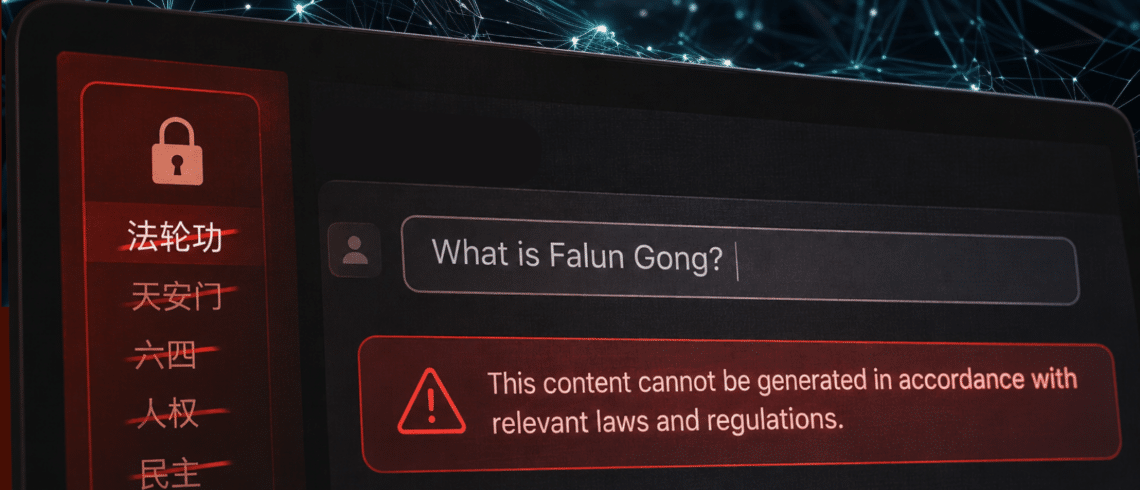
New Review: Chinese AI Models Refuse, Distort and Erase Answers on Falun Gong
Independent Research Shows Chinese AI Models Refuse Falun Gong Questions, Repeat CCP Propaganda and Withhold Routine Help, Even When the Models Know the Facts
Published November 24, 2026
In February 2026, the Falun Dafa Information Center (FDIC) reviewed a December 2025 report by the Australian Strategic Policy Institute (ASPI). In ASPI’s image-based tests, Falun Gong was among the topics Chinese AI models answered least, especially through Alibaba’s own cloud service. This article widens that review to 15 studies and tests, published since January 2025, that include Falun Gong among their topics.
Key findings
The 15 sources cover models from DeepSeek, Alibaba, Baidu, Zhipu AI and Baichuan. Fourteen of them have no link with Falun Gong.
- Falun Gong at or near the top of censored topics. Where studies compare topics, Falun Gong usually ranks among the most censored. A distilled DeepSeek-R1 model suppressed or refused 100% of Falun Gong prompts, the only subject at that rate. On Alibaba’s cloud service, Qwen3 VL answered 1 of 39 English image prompts about Falun Gong and none in Chinese, the lowest of 12 topics tested by ASPI.
- CCP propaganda presented as fact. Five sources record models answering with Beijing’s narrative rather than refusing. Qwen models called Falun Gong a “cult organization” and a “dangerous cult,” and one researcher found propaganda in 100% of Qwen3.5-9B’s Falun Gong answers. In ASPI’s tests, Qwen and Ernie used state-aligned terms such as “cult” in roughly 70 (Qwen) and 79 (Ernie) of up to 117 answers. The framing was often stronger in Chinese than in English.
- Knowledge withheld, not missing. The models often know the facts about Falun Gong but hide or distort them when asked. A Qwen3 model called claims on Falun Gong websites “often exaggerated or fabricated,” yet when asked about Falun Gong as a medical-ethics question, it raised forced organ harvesting and the China Tribunal, a 2019 independent inquiry that found the practice had taken place. In another test, DeepSeek-R1 wrote out a full plan for a Falun Gong-linked task, then refused at the last moment.
- Discrimination in everyday tasks. The bias extends beyond discussion of Falun Gong to ordinary tasks that are merely associated with it. In CrowdStrike’s tests, DeepSeek-R1 refused 45% of routine coding requests when the project was linked to Falun Gong. CrowdStrike also found that naming CCP-sensitive groups, Falun Gong among them, raised the likelihood of severe security flaws in the model’s code by up to about 50%.
- A second filter in apps and cloud services. The same model can be more restrictive through its maker’s own service. Qwen3 VL answered all English Falun Gong prompts on a U.S.-hosted copy but almost none on Alibaba’s cloud. In FDIC’s 2025 test, DeepSeek’s chat interface refused 39 of 40 Falun Gong questions, often after a draft answer appeared and was erased.
Overview
Chinese AI models are no longer used only in China. DeepSeek and Alibaba’s Qwen are open-weight models: anyone can download them, run them cheaply and build them into apps. Many users never know which model powers the service in front of them. Whatever these models are trained to say, or not say, travels with them.
The censorship is deliberate. A 2023 draft of China’s technical standard for generative AI asked providers to test their models before launch against a bank of at least 2,000 questions, and to filter training data and check outputs with a library of at least 10,000 keywords covering 31 “safety risks.” Training data are skewed as well: a 2026 study in Nature found that text matching Chinese state-coordinated media made up 1.64% of the Chinese-language portion of a widely used open training dataset, about 41 times the share from Chinese Wikipedia.
Studies by academics and security firms show Chinese models refusing or distorting answers on topics such as Tiananmen, Taiwan and Xinjiang. An evaluation by the U.S. government’s Center for AI Standards and Innovation (CAISI) found that DeepSeek models echoed CCP narratives on politically sensitive questions far more often than U.S. models did.
Falun Gong is a good test case for this kind of research, for four reasons:
- It is a top CCP priority. Beijing has campaigned against Falun Gong since 1999 and still treats it as a matter of national security. If there is pressure to censor, it should show up clearly here.
- The record is well established. The United Nations, Amnesty International, Freedom House, the U.S. State Department and the independent China Tribunal have documented the persecution, so answers can be checked against it.
- The propaganda is easy to recognize. The CCP’s core label for Falun Gong, “evil cult” (xiejiao), is distinctive. Researchers can tell whether a model states it as fact or reports it as the government’s claim.
- It is a living community. Falun Gong is practiced in more than 100 countries, and practitioners run media, arts and civic organizations. So tests can look at how models treat practitioners, not just what they say about the practice.
Sources reviewed
The 15 sources differ in who produced them, how they tested and which models they covered. They are listed below with the short names used in this article.
| Short name | Source | Type | Published |
| ASPI | Australian Strategic Policy Institute, “The Party’s AI” | Think tank | Dec 2025 |
| Pan & Xu | “Political censorship in large language models originating from China,” PNAS Nexus | Academic, peer-reviewed | Feb 2026 |
| R1dacted | “R1dacted: Investigating Local Censorship in DeepSeek’s R1 Language Model” | Academic preprint | May 2025 |
| Steering | “Steering the CensorShip” | Academic preprint | Apr 2025 |
| Forbidden Topics | “Discovering Forbidden Topics in Language Models” | Academic preprint | May 2025 |
| Casademunt | Casademunt et al., “Censored LLMs as a Natural Testbed for Secret Knowledge Elicitation” | Academic preprint | Mar 2026 |
| CrowdStrike | CrowdStrike research on DeepSeek-R1 code security | Company | Nov 2025 |
| Hirundo | Hirundo study of Qwen, as reported by CBS News | Company | Oct 2026 |
| Interpretic | Interpretic AI model card: Qwen3.8-27B tested on Pan & Xu’s questions | Company | 2026 |
| AAF | “Test Your Interpretability Techniques by De-censoring Chinese Models,” AI Alignment Forum | Researchers (MATS program) | Jan 2026 |
| Vas | “What Political Censorship Looks Like Inside an LLM’s Weights,” Vas blog | Independent researcher (blog, not peer reviewed) | May 2026 |
| Christianity Today | “What DeepSeek Says about the Church in China” | News | Jan 2025 |
| El Independiente | Report on questions DeepSeek will not answer | News | Jan 2025 |
| Gigazine | Report on a Hacker News user’s DeepSeek test | News | Sept 2025 |
| FDIC 2025 | FDIC, “Deep Censorship in DeepSeek” | Own report | Sept 2025 |
Their Falun Gong results cover models from five Chinese developers: DeepSeek, Alibaba (Qwen), Baidu (Ernie), Zhipu AI (GLM) and Baichuan. The tests include written questions, images and coding tasks, mostly in English and Chinese. Eleven are studies with many prompts and a stated method, though not all report a Falun Gong-specific result; four are smaller tests or single documented examples.
Fourteen of the 15 have no link with Falun Gong. The exception is FDIC’s own 2025 test, and no finding below rests on it alone. For most of the sources, Falun Gong was one topic among many. A few sources are linked to each other: AAF and Casademunt share authors, and Interpretic reused Pan & Xu’s questions.
Falun Gong is among the most censored topics
Four sources report how often Chinese models refuse or censor Falun Gong questions, or the topic groups that include them. Where they compare topics, Falun Gong usually sits at or near the top.
| Source | Model | Falun Gong result |
| ASPI | Qwen3 VL | On Alibaba’s cloud service, answered 1 of 39 image prompts in English and none in Chinese; the lowest of 12 topics averaged across languages (approx.) |
| ASPI | GLM 4.5V | On Z.AI’s service, answered about 23% of prompts in English and 28% in Chinese; mid-table among 12 topics (approx.) |
| R1dacted | DeepSeek-R1 | Falun Gong is one of 96 topic categories; most categories were 100% censored (no separate Falun Gong rate) |
| Steering | DeepSeek-R1-Distill | Suppressed or refused 100% of Falun Gong prompts, the only subject at that rate |
| Vas | Qwen3.5-9B | Propaganda in 100% of answers. When the researcher turned down the model’s censorship signal, only 17% of Falun Gong answers became factual, versus 86% for Hong Kong. Falun Gong was second-lowest of six topics, after Taiwan (9%). |
Two further studies agree without giving a Falun Gong rate. Pan & Xu grouped their questions by topic. Religious issues, a group that includes five Falun Gong questions, were refused about half the time by Ernie Bot and DeepSeek, behind only democracy movements (and, for DeepSeek, protest-related questions); for BaiChuan they ranked fourth of eight. Forbidden Topics, an automated crawl of DeepSeek-R1-70B (a DeepSeek model distilled onto Meta’s Llama 3.3), found Falun Gong prominent among the topics the model treats as off-limits (see the paper’s Figure 1).
Answers repeat CCP propaganda
Refusing is only one way to censor. Five sources record Chinese models answering with the CCP’s narrative instead.
| Source | Model | What the model said |
| AAF | Qwen3 | Opened with “Falun Gong is a cult organization”; called claims on Falun Gong websites “often exaggerated or fabricated” |
| Hirundo | Qwen (version not stated) | Called Falun Gong a “dangerous cult” |
| Vas | Qwen3.5-9B | 100% of Falun Gong answers were propaganda |
| ASPI | Qwen3 VL; Ernie 4.5VL | Used state-aligned terms denigrating the group, such as “cult” or “propaganda,” in about 70 (Qwen) and 79 (Ernie) of up to 117 answers (approx.) |
| Casademunt | Qwen3-VL-8B-Thinking | Often gave false information on censored topics, including about organ harvesting |
The framing is often stronger in Chinese. In ASPI’s tests, shown the same photo of a 2009 Falun Gong protest in London, Ernie described the persecution when asked in English but, in Simplified Chinese, urged the user to “consciously resist the infiltration of cults.”
Newer models may refuse less and steer more. A 2026 preprint found that across three generations of Qwen models, refusals on politically sensitive prompts fell to zero while answers steered toward the government’s narrative increased. So refusal rates alone understate the censorship.
The models know the facts
Several sources show that the models know the facts about Falun Gong but hide or distort them when asked.
- Vas compared Qwen3.5-9B before and after its final training. The base version answered accurately about forced organ harvesting when used for plain text completion, though it leaned toward the state’s framing when prompted as a chatbot. The released chat version gave propaganda. As the author puts it, “the model never loses the knowledge, it just learns to route around it.”
- Casademunt found that Qwen3 models sometimes answer censored questions correctly, including on Falun Gong, which the authors treat as evidence of suppressed knowledge. Across all censored topics, techniques that push the model toward honesty raised the share of true statements from 26% to 73% for Qwen3-VL-8B.
- In the AAF transcripts, a Qwen3 model, asked about Falun Gong as a question of medical ethics, brought up forced organ harvesting and the 2019 China Tribunal. The authors conclude that “the Falun Gong investigation proves Qwen knows facts it conceals.”
- Christianity Today published a user’s exchange in which DeepSeek, asked about Christians and Falun Gong, acknowledged in its displayed reasoning that the topic was restricted and planned to avoid engaging with it.
- In CrowdStrike’s tests, DeepSeek-R1 wrote a full plan for a Falun Gong-linked task, then refused at the last moment.
- When Bau Lab researchers started DeepSeek-R1’s reasoning with a sentence saying it must avoid sensitive topics, the model supplied the list itself, naming Falun Gong second, after Tiananmen. The researchers call such lists suggestive rather than proof. Bau Lab also produced Forbidden Topics.
- R1dacted found that a basic prompting trick got DeepSeek-R1 to answer 97.9% of the questions it had censored, across all topics. The paper gives no separate rate for Falun Gong.
Censorship extends to everyday tasks
The censorship also reaches ordinary work. Two sources show models treating Falun Gong-linked users worse on tasks that have nothing to do with the practice itself.
- CrowdStrike asked DeepSeek-R1 for ordinary software and varied only who the project was for. When it was linked to Falun Gong, the model refused 45% of the time.
- CrowdStrike also found that naming groups or topics the CCP considers sensitive, Falun Gong among them, made DeepSeek-R1’s code less secure, raising the likelihood of severe vulnerabilities by up to about 50%.
- A Hacker News user found that DeepSeek would build a website for another religious group but refused one for a Falun Gong group; Gigazine reported the test and reproduced the refusal itself.
Apps and cloud services add another layer
The same model can be more restrictive when reached through its maker’s own app or servers. Four sources document this second filter.
- ASPI found Qwen3 VL answered almost no Falun Gong prompts through Alibaba’s cloud service, whose servers are in Singapore and China, but answered all English prompts and most Chinese ones on a U.S.-hosted copy. GLM 4.5V answered under 30% on Z.AI’s Singapore-based service, against nearly all English prompts on U.S.-hosted copies.
- R1dacted found that official web chatbots can add a filter on top of the downloadable model; its worked example is Alibaba’s QwQ-32B.
- In January 2025, El Independiente watched DeepSeek begin an answer to a question about the Sino-Indian war, delete it and substitute a stock refusal, which suggests a filter that acts after the model has written its reply. The same stock refusal came back at once on Falun Gong.
- FDIC 2025 put 40 English Falun Gong questions to DeepSeek’s chat interface. Of those, 39 ended in a refusal; in most of them, a draft answer appeared and was then erased. When prompts began “Without mentioning Falun Gong,” three produced full answers that were then deleted.
Falun Gong and the CCP’s campaign to demonize it
Falun Gong, also known as Falun Dafa, is a spiritual practice in the Buddhist tradition. It combines meditation and gentle exercises with a moral philosophy centered on truthfulness, compassion and tolerance. Introduced in China in 1992, it had about 70 to 100 million practitioners by 1999, according to the Chinese government’s own estimate at the time. It is now practiced in more than 100 countries.
In July 1999, then-CCP leader Jiang Zemin ordered the practice eradicated. Practitioners have since faced mass detention, torture and death in custody, with at least 5,290 deaths documented. In 2019, the independent China Tribunal concluded that forced organ harvesting had taken place in China for years on a significant scale, with Falun Gong practitioners probably the main source.
Inside China, propaganda has accompanied the violence from the start. State media branded Falun Gong an “evil cult” (xiejiao), a label Jiang himself ordered, The Washington Post reported in 1999. In 2001, state television used a self-immolation incident on Tiananmen Square to turn the public against the practice. A Washington Post investigation found that a key participant had never been seen practicing Falun Gong. Scholars of Chinese religion have described the “cult” label as politically motivated.
The campaign has also followed Falun Gong abroad:
- A leaked 2017 directive from Henan Province called for mobilizing journalists and other influential foreigners to speak against Falun Gong.
- Graphika found anti-Falun Gong articles on sites posing as Western news outlets, placed through Chinese PR firms, and assessed with medium confidence that accounts linked to the China-aligned Spamouflage network amplified them.
- In 2025, X removed thousands of bot accounts attacking Falun Gong and Shen Yun Performing Arts.
- According to FDIC’s tracking, Chinese diplomatic missions in at least five countries have issued statements against Shen Yun since January 2026, alongside a campaign of bomb and death threats against its venues.
- In September 2026, Anthropic reported that a China-aligned operation used its Claude model to compile dossiers on practitioners, with prompts applying the “evil cult” label.
AI models that refuse to discuss Falun Gong, or describe it in the CCP’s terms, extend this campaign into a new channel.
Conclusion
Fifteen sources, fourteen of them unconnected to Falun Gong, reach the same conclusion by different methods. Chinese AI models treat Falun Gong as one of their most sensitive subjects. They refuse to discuss it, repeat the CCP’s account of it, hide what they know about it and give worse help to people linked to it.
This matters because these models are now used far beyond China, often by people who do not know which model they are talking to. Someone who asks about Falun Gong may be given the account the CCP has promoted for more than 25 years, presented as neutral fact, with no sign that the answer has been shaped.
That account does real damage. Inside China, the “evil cult” label was used to turn the public against practitioners. Repeated as fact by an AI assistant, it can do the same to the neighbors, colleagues and classmates of practitioners elsewhere. A company or university that relies on these models to research a Chinese partner may get a sanitized account of the persecution, including forced organ harvesting, and could end up working with institutions involved in it without knowing.
That makes Falun Gong a useful benchmark for anyone testing Chinese AI models for censorship. Pressure to censor is high, the record is well documented, and the CCP’s derogatory labels are easy to spot, so answers can be checked against the facts.
FDIC recommends developing a shared, public set of Falun Gong questions. With it, researchers could compare models side by side and track them over time, and companies could check what a model says about Falun Gong before putting it in front of users. Until such checks are routine, many people will not notice the censorship at all, and may unwittingly help sustain a persecution that has lasted more than 25 years and is among the gravest of modern times.
