
Elderly Woman in Shaanxi Dies in Custody Serving an Eight-Year Term for Practicing Falun Gong
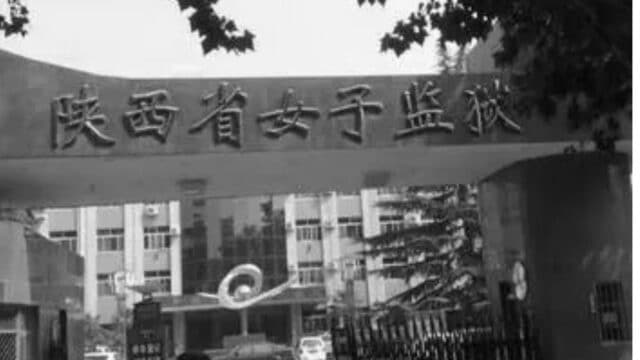
Shaanxi Province Women's Prison (Minghui)
Ms. Cao Ping (曹萍), a 74-year-old Falun Gong practitioner from Ankang City, Shaanxi Province, died in Shaanxi Province Women’s Prison in April 2026, two years after she entered the prison to serve an eight-year sentence for her faith. Her family has not been told how she died. They were permitted only a brief viewing of her body, during which they saw large bruises on her legs, and were then pressured into agreeing to an immediate cremation. Her case was reported respectively by Minghui.org and Weiquanwang on September 6.
Ms. Cao had lost the sight in one eye and had impaired vision in the other by the time she was sentenced. Every application for medical release—two filed by her lawyer during her trial and appeal, and repeated requests from her family after she entered prison—was refused.
“It’s too cruel”
In Ms. Cao’s final phone call with people outside the prison, she suddenly said, “It’s too cruel.” According to reports, a guard monitoring the call cut her off before she could finish and changed the subject. She did not explain what she meant, and her family has had no further account of her treatment.
At some point near the end of her life, the prison took her to Xi’an Aerospace General Hospital for what officials described as treatment. Her family learned this only afterward, and only through an insider.
When relatives were allowed to view her body, they saw large areas of bruising on her legs. They raised questions about the cause of death. Prison officials responded by telling them to submit their objections in writing, adding that in that case the body would not be cremated, and refused to release the body to the family. Under that pressure, the family gave way. Cao’s body was cremated in April 2026, and her cause of death remains unexplained.
Arrested on a roadside before sentencing
At around 9:00 a.m. on September 24, 2022, Ms. Cao was traveling by car with two other practitioners, Ms. Du Fengying and Mr. Chen Jun, when they stopped on a mountain road in Zaoyang Town, Hanbin District, to rest and ask for directions. Domestic security officers from the Langao County Public Security Bureau, who had been following them, arrested all three. Officers searched the car and found several Falun Gong booklets.
The three were taken to the Langao County Public Security Bureau and interrogated for a full day, pressed on how many people they had spoken to about Falun Gong and where their materials came from. They spent that night on wooden benches in the interrogation room. The following day they were transferred to detention centers. Ms. Cao was held at the Hanbin District Detention Center. Ms. Du was refused admission after her blood pressure was measured at 220 mmHg and was placed under residential surveillance at home instead.
The three were tried at the Xunyang City Court on April 23, 2023. According to reports, the judge prevented defense counsel from arguing the case and stopped Ms. Cao from addressing the legal issues, giving her no meaningful opportunity to defend herself.
On October 25, 2023, the court sentenced Ms. Cao to eight years in prison and a 50,000-yuan fine, and confiscated the personal property seized from her home—including 40,000 yuan she had set aside for her retirement. Mr. Chen was sentenced to five years and a 30,000-yuan fine. Her appeal failed, and she was taken to Shaanxi Province Women’s Prison on April 19, 2024, where she was held in the Eighth Brigade.
Ms. Du never went to prison. On September 6, 2023—while out on bail and facing continued visits and threats from municipal, district, and county officials, local police, and neighborhood committee staff—she suffered a fatal stroke. Of the three practitioners arrested that September morning in 2022, two are now dead.
Two decades of arrests and detentions
Ms. Cao was born on January 23, 1952, and worked at a department store in Ankang City’s Hanbin District before retiring. She took up Falun Gong in May 1997 after years of poor health, and reported that her illnesses resolved. After the persecution began in July 1999, she was targeted repeatedly for refusing to give up the practice.
Police broke into her home after midnight on January 23, 2000, and detained her for 15 days, followed immediately by a further 15 days. She was arrested again at work on February 24, 2000, and interrogated over ten days about the source of her Falun Gong materials before being released. On July 17, 2000, an officer summoned her to a police station on a pretext and sent her to a detention center for 15 days. On the night of October 9, 2000, more than a dozen officers entered her home, searched it, and detained her for another 15 days.
She was detained for 15 days again on January 19, 2001, held for a month after an arrest at her home on April 29, and detained for a further 15 days on May 13. On October 6, 2001, she was arrested and, ten days later, sentenced to three years of forced labor. She was released early, on July 26, 2003, only because her mother was critically ill.
In October 2004, roughly ten officials—including staff from the Hanbin District 610 Office and a visiting “assistance and education team” from Xi’an—took Ms. Cao to a brainwashing center. Her mother, by then paralyzed and bedridden, was left without a caregiver, and a relative brought her one meal a day.
On November 10, 2006, Ms. Cao was sentenced to three years of forced labor for a second time. According to reports, she was severely mistreated at the Xi’an Women’s Forced Labor Camp and on one occasion lost consciousness.
Questions the prison hasn’t answered
The record leaves a series of unanswered questions. Ms. Cao entered prison with impaired sight and a documented need for medical care, and every application for release on medical grounds was refused.
In her last contact with the outside world she said, “It’s too cruel,” and was silenced mid-sentence. Her body bore large bruises on the legs. The prison would not explain her death, would not release her body to her family, and pressed for an immediate cremation, which was carried out.
Ms. Cao’s relatives have no death certificate, no medical records, and no account of her final weeks beyond the fact of a hospital transfer they learned about secondhand. The one person who could have described what happened to her was cut off mid-sentence on a monitored phone line, and her remains were destroyed before anyone outside the prison could examine them.