
European Court: Serbia Unlawfully Banned Falun Gong Assembly During Xi Jinping’s Visit
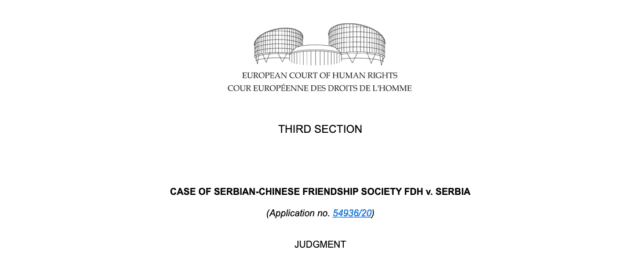
The European Court of Human Rights has ruled that Serbia violated fundamental freedoms when it banned a peaceful Falun Gong demonstration to spare Chinese leader Xi Jinping the sight of dissent during his 2016 state visit.
According to the European Court of Human Rights’ judgment issued June 2, the Strasbourg court found unanimously that Serbia breached the applicants’ right to freedom of peaceful assembly (Article 11 of the European Convention on Human Rights), as well as their right to an effective remedy (Article 13 of the Convention). The case was brought by the Belgrade-based Serbian-Chinese Friendship Society FDH (Falun Gong), represented by the Lawyers’ Committee for Human Rights.
The group had applied in June 2016 to hold peaceful protests in Belgrade timed to Xi’s state visit, hoping to draw attention to the persecution of Falun Gong practitioners in China. Serbia’s Ministry of the Interior blocked the gatherings, citing the possibility of clashes with people who might assemble to express support for the Chinese president. The court rejected that justification outright. It held that the prohibitions amounted to an interference with the right to freedom of peaceful assembly that was not “necessary in a democratic society.” Crucially, the judges found that Serbian authorities had failed to carry out a concrete and individualized security assessment, relying instead on assumptions and general references to a potential risk of confrontation. A government cannot silence peaceful speech simply because someone else might object to it.
Belgrade’s repeated bans
The 2016 case the court ruled on was no isolated misstep. By the account of practitioners, it fits a pattern of systematic suppression timed to Beijing’s diplomatic calendar. Dejan Marković, chairman of the Serbia Falun Dafa Association, welcomed the judgment while underscoring how long the abuse has gone unchecked, according to Minghui.
“This is a very important decision, although it comes after 10 years,” he said. “The Serbian authorities repeated this offense more than 20 times, in many cities all over the country, at different times, by not allowing Falun Gong practitioners to execute their constitutional right, namely the right to assembly and right to have effective legal remedy.”
To date, more than 20 lawfully announced public gatherings by Falun Gong practitioners have been banned in Serbia. The pattern traces back to 2014, when authorities arrested eleven Falun Gong practitioners in Belgrade ahead of the China summit and then deported them from the country. According to Marković, they had been detained for intending to “peacefully protest in order to raise awareness about the human rights situation in China” and about the unlawful persecution of Falun Gong.
That case eventually reached Serbia’s highest judicial body. In August 2021—seven years later—the Constitutional Court ruled in the practitioners’ favor, finding that police had unlawfully detained peaceful demonstrators and that their right to liberty and security had been violated.
The pattern repeated in 2024
The clearest proof that Serbia has not changed course came in May 2024, during Xi Jinping’s own visit to Belgrade. As reported by Radio Free Europe (Radio Slobodna Evropa), on May 7, the eve of the visit, police detained six Falun Gong practitioners along with two other people—family members with no connection to Falun Gong beyond their relatives’ involvement. All were held until the evening of May 8, and released only after Xi left Serbia aboard an official plane bound for Budapest. Serbia’s Ministry of the Interior did not respond to Radio Free Europe’s questions about why they were detained.
The accounts of those affected reveal how hollow the official silence was. Sara Marković, daughter of detainee Dejan Marković, told Radio Free Europe that police took them in without a clear explanation, claiming only that they were going for an “informational interview,” after which they were held for up to 48 hours. Her father and the others, she said, had not planned to organize any gathering against the Chinese president’s visit at all.
In her view, the motive was plain. “Our government is trying so hard to ingratiate itself with the Chinese authorities—because of economic interests, because of all the agreements and investments they are seeking from them—that they will not, by any chance, allow something as embarrassing as, for example, three people who might meditate,” she said. There are, she noted, fewer than ten Falun Gong practitioners in all of Serbia.
Serbia will change course?
Levi Browde, executive director of the Falun Dafa Information Center, welcomed the Strasbourg ruling.
“We urge the Serbian government to respect the basic human rights of Falun Gong practitioners in Serbia: the right to gather peacefully, to speak freely, and to seek justice in their own courts,” he said. “Serbia has a choice—to uphold the universal values it has committed to, or to keep doing the Chinese Communist Party’s bidding. We hope it chooses its own people’s freedom.”
For practitioners who have endured both persecution at home in China and the long reach of that repression abroad, the ruling is a vindication. As Dejan Marković put it: “We hope we will not be interfered with in future activities held to raise awareness about the persecution of Falun Gong in China. These are basic rights every European citizen should have.”