
Two Elderly Women, Years of Imprisonment, and Financial Ruin Under Beijing’s Campaign Against Falun Gong
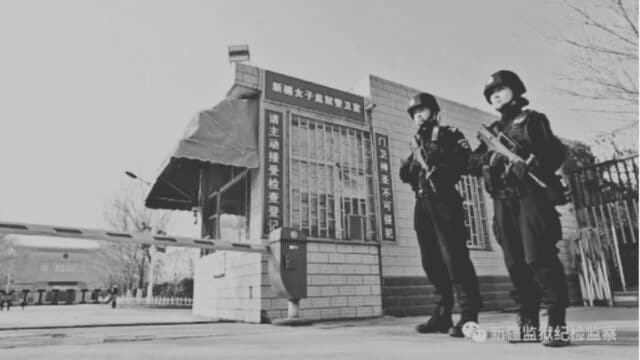
Xinjiang Women's Prison (Globalvoices.org/Edited by Faluninfo)
Ms. Cong Peishan is 87 years old. Ms. Li Xianghong is 63. After years of imprisonment and persecution for practicing Falun Gong, both women have effectively been left without income.
Both spent years in Chinese prisons and detention facilities. Both lost their livelihoods, pension rights, and family stability as a result of the Chinese Communist Party’s (CCP) campaign against the spiritual practice. Their cases, emerging from Tianjin and Xinjiang respectively, illustrate how the persecution of Falun Gong practitioners often continues long after release from custody — through financial punishment, social marginalization, and sustained political coercion.
Imprisoned at 82, widowed, now penniless
Before 1999, Cong Peishan was a retiree living in Nankai District, Tianjin. She began practicing Falun Gong in 1995 at age 56, after years of suffering from severe atrophic gastritis that medication had failed to relieve. She later said her condition improved significantly after taking up the practice, and recalled feeling physically relieved and emotionally uplifted.
After the CCP launched its nationwide campaign against Falun Gong in 1999, her circumstances changed dramatically. Beginning in 1999, Cong was arrested multiple times for refusing to renounce her faith. In December 2000, the Nankai District Court sentenced her to four years in prison. She served her term and continued practicing upon release.
In March 2021, at age 82, she was arrested again — this time after refusing to sign a written pledge to stop practicing Falun Gong demanded by the deputy director of a local police station, a man named Ren Yu, then 30 years old. “I’ll have the court sentence you,” Ren reportedly told her. “I’ll have your work unit fire you — even retirees can be fired.”
Months later, the authorities followed through. After six months in a detention center, Cong was sentenced to three years by the Nankai District Court on September 30, 2021, and transferred to Ward Five of the Tianjin Women’s Prison.
According to Minghui.org, she was then subjected to prolonged abuse intended to pressure her to renounce her faith. Ward Five head Sun Wei and team captain Zheng Yijun subjected Cong to sustained abuse aimed at forcing her to abandon her belief. For two weeks she was denied the right to wash or use the toilet, left to soil herself. Her wet padded trousers dried over days in winter cold — while guards opened windows to make the cold worse. Although prison rules exempted inmates over 60 from night duty, guards forced the 80-year-old to stand watch for four and a half hours at a stretch, multiple times nearly collapsing. She was also forced to take drugs that she later described as damaging to the nervous system. Before her release, guards compelled her to sign a statement claiming she had witnessed no abuse.
Cong was released in March 2024. She then discovered the CCP’s economic persecution had followed her out. Her monthly pension of 8,000 yuan — money she had earned over a working lifetime — was suspended on the grounds that she practiced Falun Gong. The local social security bureau offered her 693 yuan per month in living assistance instead, conditional on signing a pledge to stop practicing. She refused. The 693 yuan was then also withheld.
During her imprisonment, her husband had died. Prison guards did not tell her. She learned only after her release.
Now 87, Cong Peishan lives alone, with no income and no support. She continues to speak out about what was done to her.
Two prison terms, pension erased
Li Xianghong was a lecturer at what was then the Xinjiang Institute of Technology when she began practicing Falun Gong in 1997. She had suffered from Ménière’s disease for years; after taking up the practice, her symptoms disappeared. By all accounts she was a conscientious and well-regarded teacher.
When the persecution began in 1999, Li traveled to Beijing to appeal. That October, agents from Xinjiang’s “610 Office” — the extralegal body created specifically to oversee the suppression of Falun Gong — abducted her and committed her to the No. 4 Hospital of Urumqi, a psychiatric facility, for two months. She was held alongside male patients in mixed wards and forcibly injected with unidentified psychiatric drugs.
In August 2000, she was arrested again for distributing Falun Gong materials and held for eight to nine months in the Liudaowan Detention Center. During that detention, she undertook a hunger strike in protest. Guards force-fed her by inserting tubes through her nose — often mistakenly inserted into her airway rather than her esophagus — causing pulmonary infection, persistent high fever, and a critical deterioration in her condition. A judge came to her cell more than forty days into her hunger strike and announced a three-year sentence with outside execution. When the judge asked whether she would stop practicing, she said no.
She appealed. The appeal was denied. She was released into her parents’ custody.
In March 2002, she was arrested a third time and sentenced to eleven years. From February 2004, she was held at the Xinjiang Women’s Prison (also known as Xinjiang Second Prison), where she endured beatings, sleep deprivation, and around-the-clock forced ideological sessions. From March 2007 to early 2008, she was held in a solitary confinement cell — roughly 2.5 meters long and less than 1.6 meters wide, sealed from light — handcuffed to a floor ring, unable to move for days at a time, with recordings denouncing Falun Gong played on loop. Most people, according to accounts from the facility, suffer physical deterioration and mental disorientation within two weeks. Li endured it for nearly a year. She was eventually released on medical parole after developing recurring heart disease.
The economic consequences of the persecution unfolded alongside the physical abuse. After her first sentence in 2001, the Xinjiang Institute of Technology dismissed her, wiping out sixteen years of employment and her accumulated pension contributions — zeroed out entirely. That same year, her husband, unable to withstand the pressure, divorced her and took their child and all family assets. Li was left with almost nothing. The roughly 4,000 yuan she had remaining was confiscated by police.
Additional reporting on her economic hardship was published by Bitter Winter, an Italian online magazine on religious liberty and human rights, and Weiquanwang, a website aggregating grassroots accounts of human rights abuses in China. In 2021, she was hospitalized for cancer radiotherapy and heart surgery. Without public medical coverage — another consequence of her dismissal — her family bore tens of thousands of yuan in medical costs.
Li Xianghong is now 63, past retirement age, with no pension and no income. She lives alone.
A deliberate policy
The cases of Cong Peishan and Li Xianghong are not isolated incidents. Human rights groups and the Falun Dafa Information Center have for years documented the use of imprisonment, pension suspension, dismissal from employment, and social welfare deprivation against practitioners as part of the Chinese Communist Party’s broader campaign to eradicate the spiritual practice.
In both women’s cases, the persecution did not end upon release from custody. Instead, the economic consequences intensified with age. After years of imprisonment and abuse, both women were left without stable income or retirement security, despite decades of prior employment and pension contributions. One lost her husband while incarcerated. The other lost her marriage, career, medical benefits, and financial independence.
Their experiences also raise broader concerns about the treatment of elderly prisoners of conscience in China and the use of economic coercion as a mechanism of religious repression. By conditioning pensions or basic subsistence benefits on signed renunciations of faith, authorities effectively force elderly practitioners to choose between their beliefs and their survival.
As China’s population ages, cases such as these increasingly draw attention to the long-term human cost of the persecution campaign launched against Falun Gong in 1999 — not only in prisons and detention centers, but in the dismantling of livelihoods, families, and social protections long after formal sentences have ended.