
2025 Annual Report from U.S. Commission on China Puts Falun Gong into Focus
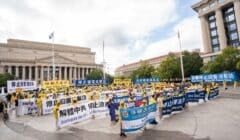
On International Human Rights Day, December 10, the Congressional-Executive Commission on China (CECC) released its Annual Report, again spotlighting the Chinese Communist Party’s (CCP) continued persecution of Falun Gong and related abuses—from torture and forced organ harvesting inside China to harassment and threats reaching the United States.
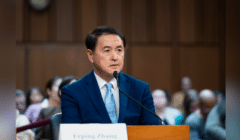
CECC Chair Senator Dan Sullivan described the report as evidence of a pattern of “Beijing’s broken promises.” In practice, Beijing signs international human rights treaties and then ignores them, while simultaneously using courts, police, and regulations as tools of political control at home and abroad.
Broken Promise #1: Convention Against Torture
The report’s executive summary underscores that torture remains commonplace across China’s detention system, including prisons, pretrial detention centers, and other facilities. Victims, including Falun Gong practitioners, face serious abuses like the “state-sanctioned harvesting of human organs.” In addition to severe torture and mistreatment in custody, the practice of organ harvesting has been “reported extensively among Falun Gong practitioners and more recently among Uyghurs.”
Framing these abuses against China’s obligations under the Convention Against Torture (CAT), ratified by Beijing in 1988. The CECC report emphasizes that the CAT definition covers any act in which severe physical or mental pain is intentionally inflicted on a person by or with the consent of officials. The report concludes that China is failing these obligations on a systemic scale.
Broken Promise #2: Chinese Constitution, Article 36
In its freedom of religion chapter, the CECC finds that the CCP and Chinese government “continue to direct considerable resources and attention” to the suppression of Falun Gong. The report cites Minghui findings that dozens of Falun Gong practitioners died due to mistreatment in custody and hundreds more were sentenced in 2024 alone.
The report also draws heavily on the CECC’s Political Prisoner Database (PPD), which now contains 11,262 records overall, including 2,755 prisoners known or believed to be currently detained. Of those with identified religious affiliation, 485 are Falun Gong practitioners, underscoring that Falun Gong remains one of the largest religious prisoner-of-conscience groups tracked by the Commission.
Despite Article 36 of the Chinese Constitution, which ostensibly protects religious freedom for Chinese citizens, the unconscionable and unconstitutional persecution of Falun Gong continues. By falsely categorizing Falun Gong is a “cult” instead of a religion rooted in Buddhism, Chinese authorities detain, charge, and prosecute practitioners under Article 300 of the PRC Criminal Law, which criminalizes “organizing and using a cult to undermine implementation of the law.”
Broken Promise #3: Chinese Constitution, Article 35
The 2025 report highlights several illustrative cases of Falun Gong practitioners, all of whom were involved to some degree in free expression and advocacy, which are ostensibly protected by Article 35 of the Chinese Constitution.
- Zuo Hongtao (Hebei Province) – Zuo was serving a 13-year prison sentence reportedly for his involvement with Falun Gong. According to the report, he became critically ill and was briefly sent to a hospital before being returned to prison; he later died. Officials allegedly blocked his family from seeing his body and cremated him without their consent, raising serious concerns about the cause of death and possible evidence destruction.
- Gao Xiaoying (Shaanxi Province) – A food inspector, Gao was sentenced to seven years in prison for posting information about Falun Gong online. His family was reportedly repeatedly turned away when attempting to visit him and was allowed only a brief meeting before his March 2024 trial, which they were barred from attending—an example of due-process violations and isolation of Falun Gong detainees.
- Zhao Ying (Guangzhou, Guangdong Province) – Over 80 years old and suffering from bladder cancer, heart disease, and diabetes, Zhao was detained in April 2021 for allegedly distributing Falun Gong materials. After a period on bail due to health concerns, she was detained again in 2024 and sentenced in October to three years and six months in prison. Rights groups cited by the Commission report that Zhao is now “dying in prison,” despite her advanced age and serious medical conditions.
These cases, drawn from both the Political Prisoner Database and external human rights reporting, also illustrate the cruel and often life-threatening conditions faced by Falun Gong practitioners in custody.
Broken Promise #4: Transnational Repression
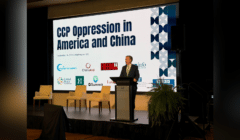
A distinctive feature of the 2025 report is a chapter on “Human Rights Violations in the U.S. and Globally,” which documents the PRC’s expanding campaign of transnational repression against diaspora communities and critics of the CCP.
The Commission describes a spectrum of tactics, including: verbal and online harassment, smear campaigns, lawfare, overseas police “service stations,” and harassment of religious groups abroad including Falun Gong practitioners. Within this context, the report specifically notes that Shen Yun Performing Arts, a classical dance company founded by Falun Gong practitioners and known for depicting “China before communism,” received dozens of bomb threats against its shows in the U.S. and around the world.
The report also references the U.S. Department of Justice case of Chen Jun, who was sentenced in November 2024 for acting as an unregistered agent of the PRC and bribing an Internal Revenue Service agent in connection with a plot targeting U.S.-based Falun Gong practitioners. This case is cited as a concrete example of how Beijing’s repression against Falun Gong now extends into U.S. institutions and legal systems.
Recommendations and Implications
As in past years, the CECC pairs its findings with concrete recommendations for Congress and the administration. Among the priorities highlighted in the 2025 report are legislation countering organ harvesting in China, targeted sanctions, and a coordinated response to CCP transnational repression.
Key recommendations include:
- Ending forced organ harvesting by expanding State Department reporting, imposing visa bans and sanctions on perpetrators, and cutting off U.S. funding and partnerships with PRC institutions implicated in unethical transplant practices.
- Developing a whole-of-government strategy to counter transnational repression, improving support for victims in diaspora communities, and coordinating with allies on sanctions and law-enforcement tools to deter harassment and covert influence.
For Falun Gong practitioners, the 2025 Annual Report is a significant reaffirmation that U.S. lawmakers are continuing to track their cases, name individual victims, and connect persecution in China with threats here in the United States. It also strengthens the policy basis for legislative efforts such as the Falun Gong Protection Act and broader measures targeting forced organ harvesting and transnational repression.
As CECC Chair Senator Sullivan noted, the Commission’s mandate is not only to document abuses, but to provide a “blueprint” for action. For Falun Gong and other communities under pressure from the CCP, how Congress and the administration respond to that blueprint in the coming year will have very real consequences.