
Human Rights Day Fair on Capitol Hill Highlights Urgent Need to Protect Falun Gong and At-Risk Communities
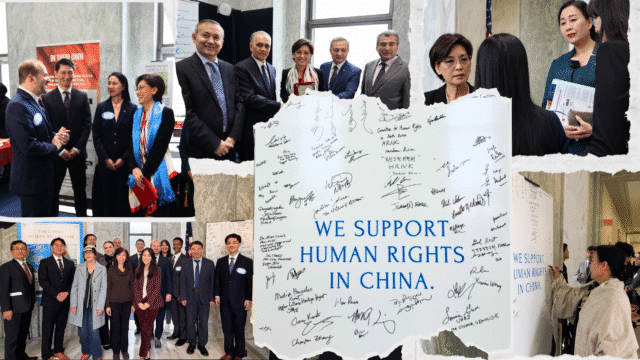
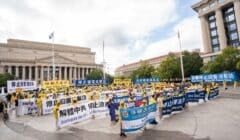
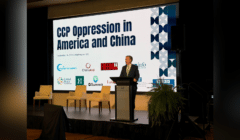
WASHINGTON — On International Human Rights Day, eleven China-focused organizations gathered in the Rayburn House Office Building on Capitol Hill to highlight the Chinese Communist Party’s (CCP) human rights abuses and an escalation of transnational repression in the United States to intimidate and silence critics.
The daylong China Human Rights Fair brought together Chinese dissidents, Falun Gong practitioners, Uyghurs, Tibetans, Christians, Hong Kongers, Southern Mongolians, and North Korean refugees, along with human rights researchers and policy analysts. Organizers said the goal was to give congressional staff and members a chance to speak directly with survivors and experts in an informal setting.
“Human rights and religious freedom are often forgotten in lieu of hard power and economic concerns,” said Cynthia Sun, senior researcher at the Falun Dafa Information Center. “This fair is about closing that gap to reprioritize human rights in China for Congress.”
The event was hosted by the Falun Dafa Information Center, with special logistical support from Representative Young Kim’s office.
Recurring themes of CCP control
At the Falun Gong booth, two themes surfaced repeatedly: the recent persecution of U.S. residents’ family members inside China and the Chinese Communist Party’s transnational repression of diaspora communities overseas. More than 26 years after Beijing launched its nationwide campaign against Falun Gong, practitioners and their relatives continue to face arrests, harassment, and surveillance—especially around politically sensitive dates such as the July 20 anniversary marking the start of the persecution. Citing ongoing reports of torture, arbitrary detention, lengthy prison terms, and efforts to force detainees to renounce their beliefs, Sun described the CCP’s campaign as “a spreading cancer.”
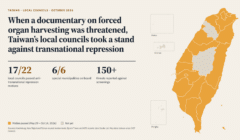
Jessica Russo, a member of the Doctors Against Forced Organ Harvesting, presented accounts of medical crimes targeting practitioners in custody. Pointing to years of reporting and investigations whistleblowing forced organ harvesting from prisoners of conscience, Russo explained Falun Gong practitioners were found to be the primary source for organs for China’s black market at one point.
Falun Gong, also known as Falun Dafa, is a spiritual discipline that combines gentle exercises and meditation with moral teachings based on the principles of truthfulness, compassion, and forbearance. The practice gained widespread popularity in China during the 1990s before being banned and violently suppressed by the CCP beginning in July 1999.
Multiple exhibitions also drew attention to transnational repression—efforts by the CCP and its proxies to pressure, intimidate, and silence critics outside China, including in the United States. Community members and organizers cited incidents of online harassment, smear campaigns, impersonation, doxing, surveillance of peaceful activities, pressure on venues to cancel events, and harassment of family members still in China. Sun noted that performances and events that depict human rights abuses in China, including Shen Yun Performing Arts, have repeatedly faced organized efforts by Chinese-backed individuals and groups to disrupt their shows and distort their message.
Policy recommendations for Congress
Throughout the fair, congressional aides asked what concrete steps Congress could take. While international awareness of these human rights violations has grown, accountability for individual perpetrators has been limited, so organizations called on U.S. lawmakers to adopt stronger measures.
The Falun Dafa Information Center highlighted three priority recommendations in particular that would directly address risks facing Falun Gong practitioners:
- Pass the Falun Gong Protection Act in the Senate
On May 5, 2025, the U.S. House of Representatives passed the Falun Gong Protection Act, a bipartisan bill aimed at investigating and sanctioning individuals involved in forced organ harvesting from Falun Gong practitioners and other prisoners of conscience.
Next, the Senate Foreign Relations Committee should schedule the legislation for consideration in January 2026 and move it toward a floor vote. Its passage would send a clear signal that the United States will not tolerate organ trafficking tied to Beijing’s religious persecution. - Impose targeted sanctions and condemn persecution
We urge lawmakers to encourage the use of tools such as Global Magnitsky sanctions and visa restrictions. In addition, continue the sustained, public condemnation of Beijing’s crimes against humanity, including statements and resolutions around the July 20 anniversary of the start of the persecution on Falun Gong. - Support victims and investigations of transnational repression
Congress and relevant agencies should strengthen mechanisms to monitor and document harassment, threats, impersonation and disinformation campaigns directed at Falun Gong practitioners and other diaspora communities in the United States. In addition, for transnational repression to be raised consistently in official dialogues with Chinese counterparts, alongside other human rights concerns.
For more policy one-pagers from organizations at the fair, please access our secure folder of materials here.